

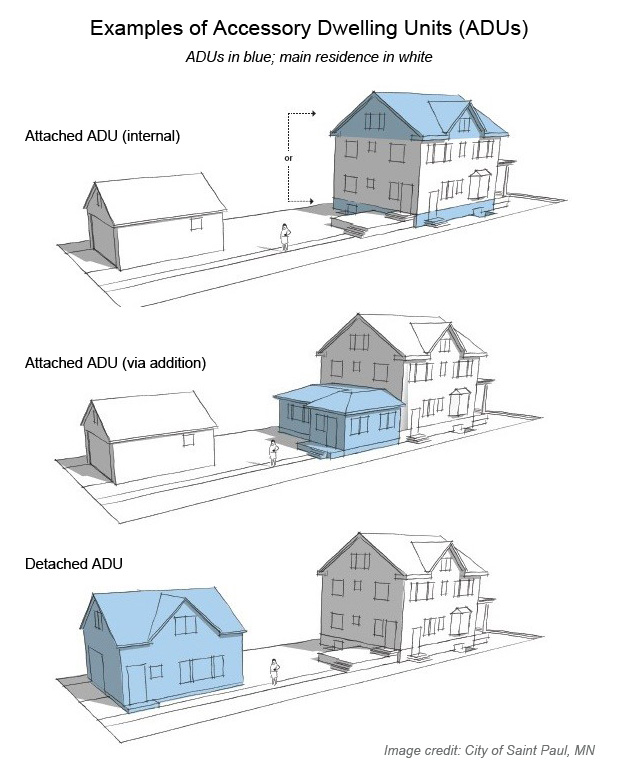
HB 1337 requires Washington cities inside urban growth areas to allow at least two ADUs on residential lots, bans owner-occupancy requirements, and sets floors for size, height and parking that local codes cannot go below. Cities in King, Snohomish and Pierce counties had to bring their codes into line by mid-2025, and most did so through ordinances adopted in 2024 and 2025. Where a city’s code still conflicts with the state law, the state rules apply instead.
The law sets a minimum, not a uniform rulebook. Some cities adopted exactly what the state requires; others went further, and a few kept local details that matter for real projects. This article summarizes the state baseline and then shows where fourteen Puget Sound cities landed. For the background of the law itself, see our backyard team’s explainer on what HB 1337 changed.
The State Baseline Every City Must Meet
These rules come from RCW 36.70A.680 and 36.70A.681. Cities can be more generous, but not more restrictive.
At least two ADUs per lot in residential zones that allow single-family homes, in any combination: one attached and one detached, two attached, or two detached.
No owner-occupancy requirement for the house or the ADU.
A maximum size limit, if a city sets one, of no less than 1,000 square feet.
A height limit for ADUs of no less than 24 feet, unless the main house itself has a lower limit.
No off-street parking requirement within half a mile walking distance of a major transit stop, and caps on how much parking can be required elsewhere. Narrow exceptions exist, including areas close to Sea-Tac Airport.
Impact fees for an ADU capped at half of what the main house would pay.
Setback, lot coverage, tree retention and design rules no stricter than those for the main house, and permission to place a detached ADU right on a property line shared with a public alley.
Conversion of existing structures, such as detached garages, even when they do not meet current setback or lot coverage rules.
No ban on selling an ADU as a condominium unit.
What Cities Can Still Regulate
The law leaves several tools with local governments. Cities may restrict the use of ADUs as short-term rentals. They may prohibit ADUs on lots that are not connected to public sewer, and the ADU provisions do not apply to lots with critical areas or their buffers, such as wetlands, steep slopes and fish habitat. Building, fire and energy codes apply as they do to any dwelling.
That is why two lots in the same city, both zoned for houses, can have very different ADU options.
How Puget Sound Cities Adopted HB 1337
The summaries below reflect each city’s adopted code as of this writing. Codes continue to be amended, so treat these as a starting point and confirm the current version before you design.
Seattle
Seattle adopted its HB 1337 update effective June 30, 2025, followed by a permanent rewrite of its Neighborhood Residential zones on January 21, 2026. Two ADUs are allowed in any mix of attached, detached or stacked, at up to 1,000 square feet, or 1,200 square feet with three or more bedrooms. ADUs get the same height as houses in the zone and need no parking. The full picture is in our guide to Seattle ADU and DADU rules.
Bellevue
Bellevue adopted middle housing and ADU code amendments in June 2025, extending earlier reforms that removed owner occupancy and allowed condominium sales. The update moved Bellevue from allowing one attached unit to allowing two ADUs, including detached units. Confirm the final adopted size, height and parking standards in the Land Use Code, since the online version has lagged behind the ordinance.
Kirkland
Kirkland adopted its update in June 2025. It allows two ADUs, attached or detached, with a 1,200-square-foot size limit, and waives parking near major transit. Kirkland also allows a detached ADU to be owned separately, including on its own unit lot.
Bothell
Bothell allows two ADUs on most lots, reduced to one where the lot also has middle housing or critical areas. The size limit is 1,200 square feet, with flexibility for conversions of existing space, and detached ADUs can reach 30 feet in height.
Issaquah
Issaquah adopted its update in 2025. Two ADUs are allowed in any combination, each up to 1,000 square feet, with garages, storage and decks excluded. A local twist: the main home must remain at least 25 percent larger than the largest ADU, and each ADU needs its own address and a walkway to the street.
Everett
Everett went well beyond the state minimum. Under its Everett 2044 development regulations, effective July 2025, most neighborhood residential zones have no fixed cap on the number of ADUs, while one zone keeps a limit of two. Smaller units need no off-street parking, and the city reduces or waives certain fees for the first ADUs on a lot.
Snohomish
The City of Snohomish allows up to two ADUs and does not set a maximum ADU size; setbacks and lot coverage control the footprint instead. Height is set by location on the lot. If an ADU is used as a short-term rental, the owner must live on site, and ADUs are not allowed in critical areas or their buffers.
Mill Creek
Mill Creek adopted its update in 2025. Two ADUs are allowed per lot, each capped at 1,000 square feet with a small minimum size, and one parking space per ADU applies unless frequent transit such as a Swift station is close by. Applicants also need confirmation from the water and sewer districts that they can serve the new unit.
Lynnwood
Lynnwood replaced its zoning code with a new Unified Development Code effective July 1, 2025. ADUs are defined as units of 1,000 square feet or less. The older code, which limited lots to one ADU and required owner occupancy, no longer governs, even though copies of it still appear online.
Shoreline
Shoreline adopted its update in early 2025 with later amendments. Two ADUs are allowed, attached or detached, up to 1,200 square feet, subject to the zone’s density calculation, and there is no owner-occupancy requirement.
Mountlake Terrace
Mountlake Terrace rewrote its residential districts in 2025. Two ADUs are allowed per lot outside critical areas, each between 200 and 1,000 square feet, with no parking or street improvements required and garage conversions allowed.
Lake Forest Park
Lake Forest Park allows up to two ADUs on single-family lots, up to 1,000 square feet and 25 feet tall in an accessory building. A DADU may sit at the rear lot line where it abuts an alley the city does not plow. Public sewer is required, and one parking space per ADU applies unless the lot is near major transit.
Edmonds
Edmonds was an early adopter, updating its code in June 2024, and reorganized its single-family zones into three low-density overlays in 2025. Two ADUs are allowed, 24 feet tall when detached, with the size limit depending on the overlay. The first ADU needs no parking; a second may need one space away from major transit.
Tacoma
Tacoma adopted its Home in Tacoma Phase 2 code in November 2024. Two attached or detached ADUs are allowed on any legal lot, up to 1,000 square feet of living area, with no parking requirement. Detached units go in the rear yard, and a voluntary bonus program comes with its own conditions.
Patterns Worth Noticing
Size limits split into two groups: cities that kept the state’s 1,000-square-foot floor (Seattle for most units, Issaquah, Lynnwood, Mountlake Terrace, Lake Forest Park, Tacoma) and cities that allow 1,200 square feet (Kirkland, Bothell, Shoreline, and most of Edmonds). Snohomish sets no cap at all.
Parking varies more than any other rule. Seattle, Mountlake Terrace and Tacoma require none, Edmonds exempts the first ADU, several suburbs still require a space outside transit areas.
Local twists are usually about the lot, not the unit: sewer connection, critical areas, alleys and how ADUs interact with new middle housing allowances.
What This Means for Your Project
Start with the state baseline, then read your city’s code for the details that apply to your specific lot. Because local twists usually come from the lot itself, a free lot feasibility report is a sensible next step, and the ADU and DADU packages show the unit sizes that fit within most of these limits. United Signature builds across the region; find your area on the locations page.
FAQ
What happens if my city’s code still conflicts with HB 1337?
The state law says its requirements supersede and preempt conflicting local development regulations in cities that have not updated their codes. In practice, a permit reviewer applies the state minimums where local code falls short.
Does HB 1337 apply to rural properties?
The ADU requirements apply inside urban growth areas. Rural lots outside those areas follow county rules, which are often more limited.
Can my city stop me from renting the ADU on Airbnb?
Yes. HB 1337 lets cities restrict short-term rentals of ADUs, and several Puget Sound cities license or limit them.
My permit application was filed before my city updated its code. Which rules apply?
Washington generally applies the rules in effect when a complete permit application is filed. If you applied under the older code, ask the city whether you can revise the application or reapply under the newer, often more flexible rules.
Is HB 1337 the same as the middle housing law?
No. HB 1337 covers ADUs. HB 1110 is the separate middle housing law that requires cities to allow more homes per lot, such as duplexes and fourplexes. Many cities implemented both in the same ordinance.