

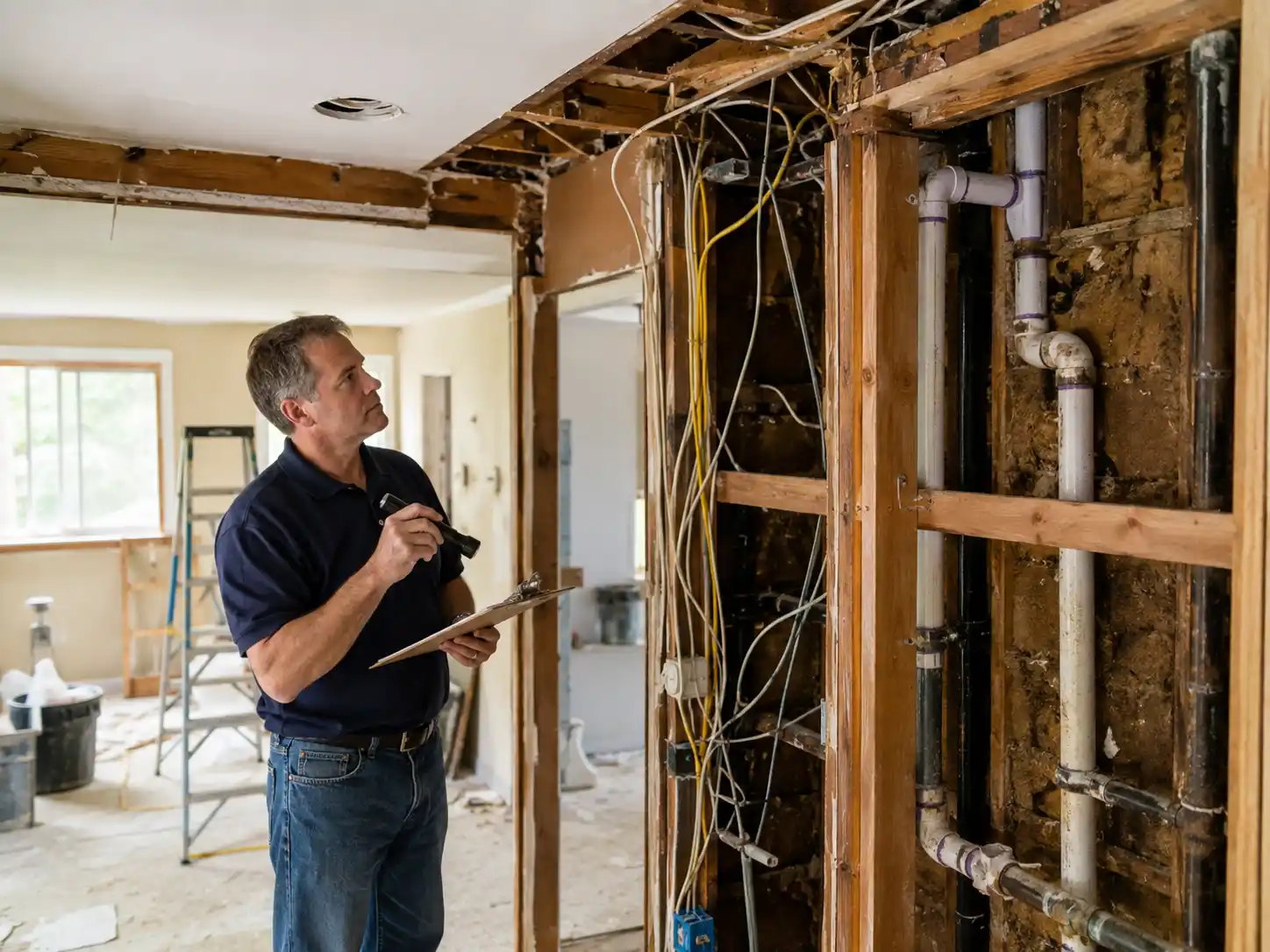
A contractor opens a wall and finds a beam that does not appear on any plan.
A basement contains a bathroom that does not appear in available permit records.
An addition looks professionally finished, but the homeowner cannot locate documentation.
A stair was moved.
A structural wall was removed.
What happens next?
The first step is not panic.
The second step is not covering it back up.
Unpermitted work needs to be understood before new construction is built around it.
Seattle states that construction performed without required permits can lead to stop-work orders, fines, and other enforcement. The practical path for an older condition depends on what was built, when it was built, whether it complies, what current work touches it, and what SDCI requires for the specific property.
This article is construction guidance, not legal advice.
How Do You Know the Work Was Unpermitted?
Absence of an immediately available permit record is a warning sign, not always definitive proof.
Older records can be incomplete or stored differently.
Addresses and parcel records can change.
A permit may exist under a broader project description.
Start by researching the property.
Seattle provides tools to research projects, permits, and property history.
Compare:
– current layout;
– permit records;
– inspection history;
– old drawings;
– seller documents;
– and visible construction.
If the question matters to the remodel, contact SDCI or the appropriate jurisdiction for clarification.
Common Unpermitted Conditions Found During Remodeling
Typical examples include:
– basement bedrooms;
– added bathrooms;
– kitchen relocations;
– garage conversions;
– decks;
– additions;
– removed walls;
– large window or door openings;
– electrical circuits;
– plumbing;
– gas piping;
– and structural modifications.
Not every condition has the same risk.
A nonstructural finish alteration is different from an unsupported beam or unsafe electrical work.
The project team should prioritize life safety and structure.
Why It Often Appears During Demolition
Finished walls hide history.
A room can look normal while framing behind it was altered years ago.
When demolition exposes the assembly, the contractor may see:
– cut joists;
– missing headers;
– undersized beams;
– disconnected supports;
– plumbing through framing;
– unsafe wiring;
– concealed rot;
– or materials that do not match expected construction.
This is why Hidden Problems in Older Seattle Homes That Can Change a Remodel Budget is not just about age.
Past remodeling creates its own hidden conditions.
Do Not Assume the Current Contractor Created the Problem
If the condition predates the project, document it.
Photographs are useful.
The contractor should identify what was found and how it affects the contracted scope.
Do not immediately demolish evidence unless safety requires action.
The homeowner may need the information for permit discussions, design, insurance, a real-estate matter, or other professional advice.
Good documentation separates an existing condition from new construction.
Can the Contractor Continue Working?
Sometimes work in unaffected areas can continue.
Sometimes the discovered condition blocks the next step.
If the project needs to connect to the unpermitted work, the design may need revision before proceeding.
If there is an immediate structural or electrical hazard, work around the condition may need to stop.
If the City issues a stop-work order, the project must comply with that order.
Seattle states that it may issue stop-work orders for work started without required permits.
The exact response should be coordinated with SDCI and the project professionals.
What If the Unpermitted Work Is Structural?
Structural work usually requires more careful evaluation.
Example:
A previous owner removed a bearing wall and installed a beam.
The beam may look substantial.
That does not prove:
– it is correctly sized;
– the connections are adequate;
– the posts have support below;
– the foundation can carry the load;
– or lateral resistance was addressed.
A structural engineer may need to verify the condition or design corrections.
Use When Does a Home Remodel Need a Structural Engineer? for the main triggers.
If the current remodel already plans to alter the same area, the most efficient solution may be to redesign the structure as part of the permitted project.
What If the Work Is Electrical?
Unpermitted electrical work can be especially important because much of it becomes concealed.
A licensed electrical contractor may need to evaluate exposed conditions.
Depending on circumstances, portions may need correction before approval.
Do not assume that because lights work, the wiring is compliant.
The current remodel’s electrical permit does not automatically validate every previous circuit in the house.
What If It Is Plumbing or a Bathroom?
A previous bathroom can involve:
– water supply;
– drains;
– venting;
– waterproofing;
– ventilation;
– electrical;
– and legal use.
If the bathroom is being remodeled anyway, opening the space may create an opportunity to correct the work and obtain appropriate permits.
The permit path should be coordinated with Public Health – Seattle & King County for plumbing/gas scopes and SDCI for applicable building and trade work.
Review the Seattle Remodel Permit Checklist for the separate authorities.
Can You Get a Permit After the Work Was Done?
There is no single automatic process that applies identically to every old condition.
Seattle can require permits and corrections for construction done without required approval.
The owner may need to provide drawings or documentation and demonstrate compliance.
Concealed work can be difficult to verify.
That may require selective opening.
Work that does not comply may need correction.
In some situations, a use or living unit may not be legalizable as built.
Seattle specifically warns that illegal living units may have been installed without permits and may not meet zoning or safety standards.
Do not promise a homeowner that an old basement apartment can simply be “grandfathered.”
The jurisdiction needs to review the actual condition.
Does Old Work Automatically Get Judged Under Today’s Code?
Existing-building code questions can be complex.
The applicable requirements can depend on:
– age;
– scope;
– use;
– current alteration;
– safety condition;
– and the code path used by the jurisdiction.
Do not tell homeowners that every old condition must automatically be rebuilt exactly to all current new-construction standards.
Also do not tell them old work is automatically legal because “it has been there for twenty years.”
Both statements can be wrong.
This is a project-specific code question.
How Does Unpermitted Work Affect the Budget?
It creates uncertainty in three areas.
Design.
The current plan may need to change.
Construction.
Existing work may need opening, demolition, reinforcement, or replacement.
Permitting.
Additional drawings, engineering, revisions, inspections, or agency coordination may be required.
That is exactly why the reserve in How Much Contingency Should You Budget for a Home Remodel? should reflect unclear renovation history.
A property with several undocumented alterations carries more uncertainty than an identical home with complete records.
How Does It Affect the Schedule?
The schedule can pause while:
– records are researched;
– engineers inspect;
– drawings are revised;
– permit questions are resolved;
– additional approvals are obtained;
– or corrective work is designed.
The best way to reduce delay is to surface the question early.
If permit history looks unclear during preconstruction, research it before demolition.
If the contractor notices suspicious structural conditions during the initial walkthrough, consider exploratory investigation before the construction calendar is locked.
Should You Report Previous Work?
The correct legal and regulatory obligations depend on the situation.
A construction blog should not give homeowners instructions to conceal violations or evade permits.
If unpermitted work affects the current project, safety, legal use, or required approvals, discuss it with SDCI and qualified project professionals.
For real-estate disclosure, liability, or legal-right questions, consult a qualified Washington attorney or real-estate professional.
How a Contractor Should Handle the Discovery
A professional process looks like this:
1. Stop work in the affected area when necessary.
2. Photograph and document the condition.
3. Determine whether there is an immediate safety issue.
4. Research available permit information.
5. Bring in the appropriate engineer or trade professional.
6. Clarify permit requirements.
7. Prepare the corrective scope.
8. Price and document the change.
9. Obtain required approval before covering new work.
10. Update the schedule.
This protects the homeowner far better than “we found something weird, but we covered it.”
FAQ
Can Seattle fine homeowners for unpermitted construction?
Seattle states that construction without required permits or without final approval can lead to fines or other enforcement, including stop-work action.
Can old unpermitted work be legalized?
Sometimes a path exists, but the City may require documentation, inspection, and corrections. The answer depends on the actual work and property.
What if the previous owner did the work?
That may matter to legal or real-estate questions, but the current construction still needs to address unsafe or noncompliant conditions encountered by the project.
Does a contractor have to fix all unpermitted work in the house?
Not automatically. The impact depends on the current scope, safety, permitting, and what the jurisdiction requires.
Should I buy a house with unpermitted work?
That is a due-diligence decision. Understand what was built, whether it can be permitted or corrected, and the likely cost before relying on the space.