

One of the most reliable ways to control kitchen-remodel cost is to keep major plumbing close to its existing location.
That does not mean the kitchen must keep the same cabinets.
It does not mean the room cannot become open concept.
It does not mean the island cannot change.
It means the design treats existing infrastructure as an asset instead of moving it automatically.
In many projects, avoiding major sink and drain relocation can save several thousand dollars. In difficult slab conditions or large kitchen relocations, the savings can be much greater because the project also avoids concrete cutting, long drain runs, vent changes, structural conflicts, and finish repair.
The exact savings depend on the house.
The important point is that plumbing location should be considered before the design becomes fixed.
What Does “Not Moving Plumbing” Actually Mean?
It does not always mean the sink remains within one inch of the old location.
A modest shift along the same plumbing wall may be relatively straightforward.
A dishwasher can often change sides.
A refrigerator water line may be relocated more easily than a sink drain.
The real cost jump often occurs when the new layout requires a fundamentally different drain and vent route.
Use How Much Does It Cost to Move Plumbing During a Remodel? to understand why distance is only one part of plumbing complexity.
Why the Drain Matters More Than the Water Lines
Water-supply lines are relatively small.
Kitchen drainage is larger and needs proper slope and venting.
Moving the sink across floor joists, to an island, or across a slab can create substantially more work than extending hot and cold supply lines.
That is why kitchen savings often come from preserving the drain location.
If the sink stays near the existing stack, the design team gains more freedom to spend money elsewhere.
How Much Can You Save?
There is no universal plumbing-savings number.
A simple same-wall move may only save a few thousand dollars compared with a modest relocation.
Avoiding a difficult island drain, slab cut, or long relocation can save much more.
The savings can also extend beyond the plumber.
Keeping plumbing in place can reduce:
– demolition;
– structural framing coordination;
– concrete repair;
– ceiling repair below;
– permit complexity;
– drywall;
– flooring repair;
– and construction time.
That is why the total project savings can exceed the plumbing invoice itself.
The existing article How Much Does a Kitchen Remodel Cost? is useful for viewing these savings inside the broader kitchen budget.
Can You Still Change the Kitchen Layout?
Yes.
A kitchen can change substantially while the sink remains near the same wall.
Possible changes include:
– replacing a U-shaped layout with an L-shaped kitchen;
– adding an island;
– moving the refrigerator;
– moving pantry storage;
– changing appliance sizes;
– removing a non-plumbing wall;
– changing cabinet configuration;
– or creating a wider connection to the living room.
The Kitchen Layout Guide should be used to test alternatives around fixed infrastructure.
A strong designer can often create several layouts before deciding that plumbing relocation is necessary.
What About an Island Sink?
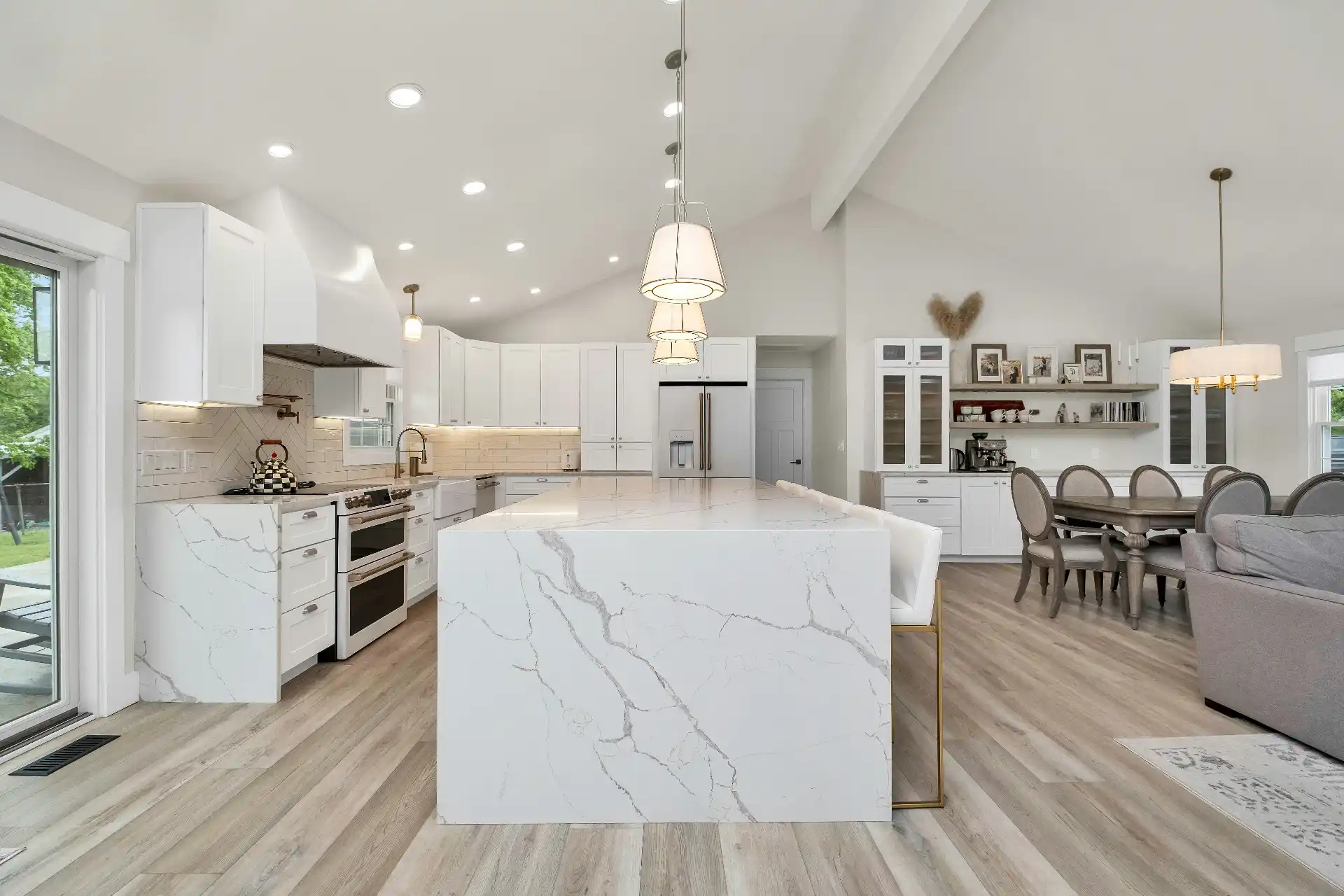
An island sink can be useful when it improves workflow.
It also adds plumbing complexity.
The project needs drainage, water, and an appropriate venting strategy at the island.
The floor construction matters.
The island location should therefore be driven by function rather than the assumption that every large kitchen needs a sink in the center.
Sometimes a dry island with uninterrupted prep space is more useful and less expensive.
The Kitchen Island Size Guide can help evaluate whether the island needs plumbing at all.
When Moving Plumbing Is Worth the Cost
Saving money is not the only goal.
Move plumbing when keeping it in place creates a kitchen that still does not work.
Examples:
– sink is trapped in a poor corner;
– window location creates a better sink zone;
– old kitchen is being relocated entirely;
– island prep sink significantly improves two-cook workflow;
– addition changes the room geometry;
– or accessibility requires a different layout.
A $5,000 or $10,000 plumbing decision can be worthwhile inside a large project if it materially improves the house for decades.
The question is not “Can we avoid the cost?”
It is “What do we gain by spending it?”
Can You Save Money by Keeping the Kitchen in the Same Room?
Usually, yes.
Keeping the kitchen in the same room tends to preserve:
– plumbing;
– ventilation routes;
– electrical infrastructure;
– exterior openings;
– and floor-plan relationships.
A kitchen relocation can still be the correct choice.
But it should be compared against the cost detailed in How Much Does It Cost to Move a Kitchen to Another Room?.
Sometimes a $30,000 infrastructure premium transforms the entire main floor.
Sometimes it only moves the same problems to another room.
Electrical and Ventilation Still Matter
Keeping plumbing in place does not make the remodel “simple.”
New appliances may require new circuits.
Induction cooking may affect electrical capacity.
A larger range hood may need a new duct.
Lighting can be completely redesigned.
The main savings are from preserving the wet infrastructure, not from eliminating all trade work.
If the kitchen is part of a broader remodel, use How Much Contingency Should You Budget for a Home Remodel? to keep concealed-condition risk separate from deliberate design changes.
Older Plumbing May Still Need Replacement
Keeping the sink location does not mean reconnecting new fixtures to failing piping without evaluation.
If demolition exposes old galvanized supply pipe, corrosion, deteriorated drains, or previous repairs, the project should evaluate whether replacement makes sense while walls are open.
See Galvanized Plumbing in Older Homes: Should You Replace It During a Remodel?.
The goal is to avoid unnecessary relocation, not necessary infrastructure repair.
How to Design Around Existing Plumbing
Use this process:
1. Locate existing drain and supply routes.
2. Identify how far the sink can move economically.
3. Draw the best layout with the sink near that zone.
4. Draw a second layout with unrestricted plumbing movement.
5. Compare function.
6. Price the difference.
7. Decide whether the functional improvement is worth the plumbing premium.
This gives the homeowner a real choice.
A design team should not move plumbing merely because it is easy to draw.
How Much Should Plumbing Influence the Final Kitchen?
Enough to control waste.
Not enough to force a poor room.
In a moderate kitchen remodel, infrastructure efficiency can be one of the strongest cost controls.
In a large whole-house remodel, the kitchen may deserve greater freedom because other floors and walls are already open.
The Kitchen Remodel Cost Guide should help determine which project type you are actually planning.
FAQ
How much money can I save by not moving the kitchen sink?
The savings vary from a few thousand dollars to substantially more in difficult slab or long-distance relocation conditions.
Can I move the sink a little without major cost?
Often, especially along the same wall or within a favorable framing bay. A plumber should evaluate the actual route.
Is an island sink expensive?
It can add plumbing and venting complexity, particularly in slab floors or finished rooms below.
Should I keep old pipes just to save money?
No. Keeping the fixture location and retaining deteriorated piping are different decisions.
Is keeping plumbing in place the best way to save on a kitchen remodel?
It is one of the strongest structural cost-control strategies, along with limiting wall removal and avoiding unnecessary appliance/service changes.