

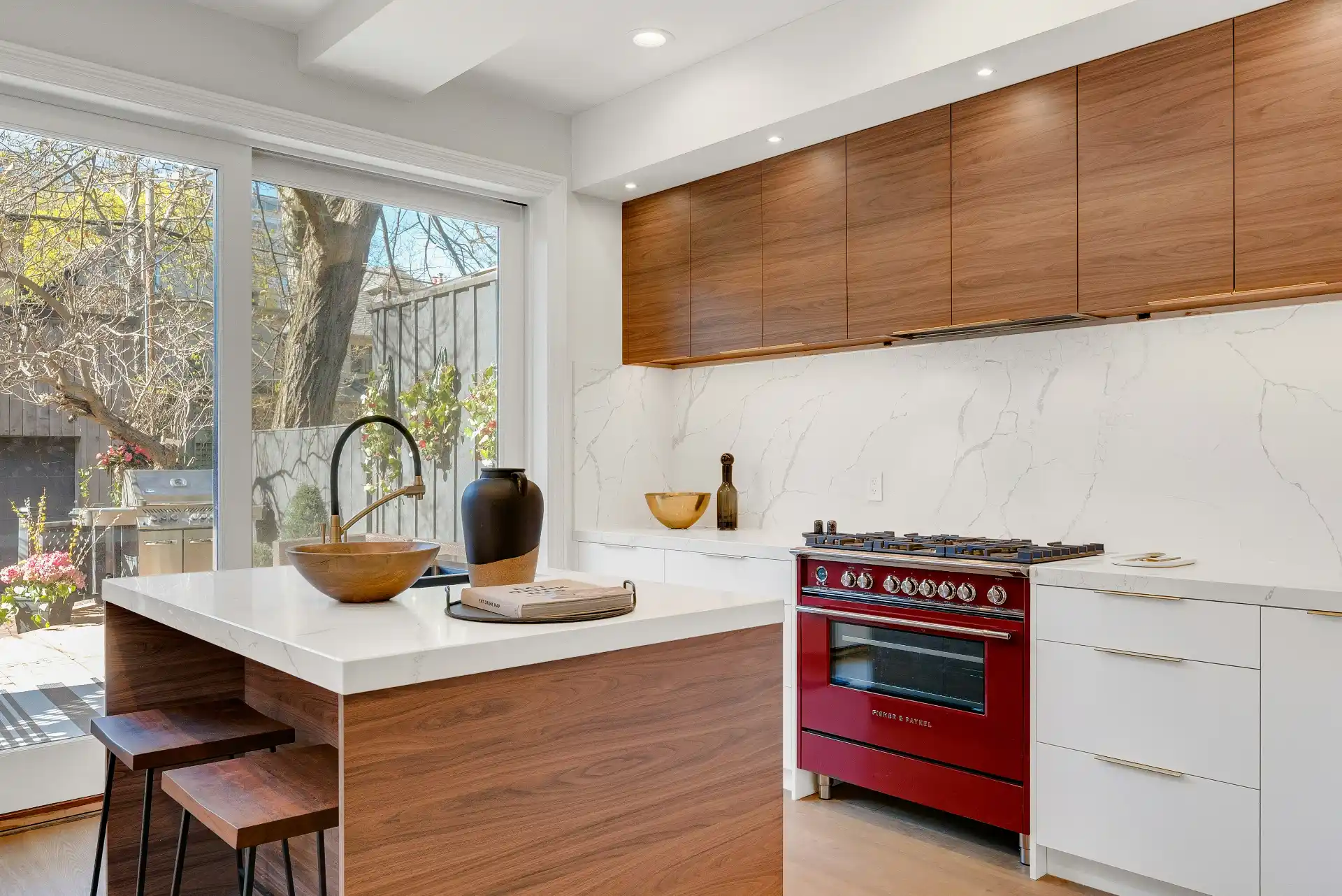
Choosing between induction and gas is no longer only an appliance decision.
During a remodel, it can affect:
– electrical service;
– branch circuits;
– gas piping;
– ventilation;
– cabinetry;
– countertop cutouts;
– appliance dimensions;
– and long-term electrification plans.
A homeowner replacing one range in the same location may face a straightforward choice.
A whole-house remodel converting several gas appliances to electric should evaluate the entire electrical load before the kitchen is finalized.
That is why cooking technology belongs in early design.

How Induction Works
Induction cooking uses electromagnetic fields to heat compatible cookware directly.
The cooktop surface itself does not heat food in the same way as a traditional electric resistance element.
Heat is generated in the cookware.
Practical advantages often include:
– rapid response;
– precise control;
– smooth glass surface;
– easy cleanup;
– and less waste heat released around the pan.
The main remodel implication is electrical power.
Full-size induction ranges and cooktops commonly require a dedicated high-capacity circuit sized according to the specific appliance.
The electrician needs the actual equipment specification.
Do not design the electrical circuit from a generic assumption.
How Gas Cooking Works
Gas burners create an open flame beneath cookware.
Many cooks value:
– visible flame;
– immediate response;
– compatibility with nearly all cookware;
– and familiarity.
The remodeling implications include:
– gas supply;
– shutoff;
– combustion;
– ventilation;
– and clearances required by the appliance.
If the house already has gas at the kitchen and the appliance remains similar, replacement may be relatively simple.
If the kitchen moves or the gas line is being removed as part of electrification, the scope changes.
Ventilation Matters With Either Choice
A range hood is useful with both gas and induction cooking.
Cooking itself produces:
– moisture;
– grease;
– odors;
– and particles.
Gas additionally creates combustion byproducts.
The hood should therefore be designed around cooking style, appliance width, manufacturer requirements, duct route, and applicable mechanical code.
Seattle mechanical permits cover kitchen hood exhaust systems when permit work applies.
Ventilation should be designed around the actual appliance, duct route, and cooking habits rather than treated as a decorative afterthought.
Electrical Capacity Can Decide Whether Induction Is Easy or Expensive
If the existing house has sufficient service capacity and an appropriate circuit can be routed easily, switching to induction may be straightforward.
If the panel is full or the house is already adding:
– heat pump;
– EV charging;
– electric water heating;
– electric dryer;
– and other major loads,
the kitchen appliance can become part of a larger service-capacity discussion.
Use Should You Upgrade Your Electrical Panel During a Major Remodel? before assuming the appliance price represents the full conversion cost.
Seattle requires an electrical permit when wiring is installed, altered, extended, or connected to electrical equipment.
That means a new induction circuit is part of permitted electrical work.
Cookware Compatibility
Induction requires cookware that interacts with the magnetic field.
Many cast-iron and magnetic stainless-steel pans work.
Some aluminum, copper, glass, or nonmagnetic cookware may not unless designed with an induction-compatible base.
A simple magnet test can provide an initial indication, but appliance and cookware manufacturers should be consulted.
Replacing cookware can be a minor hidden cost of switching.
For a homeowner with a large premium cookware collection, check compatibility before ordering the cooktop.
Cooking Control
Both gas and induction can provide strong cooking control.
The experience is different.
Gas gives a visible flame and works with many pan shapes.
Induction can respond very quickly and maintain low settings effectively on compatible cookware.
The best choice depends partly on cooking habits.
A serious wok user may have different priorities from a family primarily boiling, sautéing, and simmering in flat-bottom pans.
Test the technology if possible before designing the whole kitchen around it.
Cleaning
Induction’s smooth surface can be easier to wipe because food is less likely to burn onto a hot radiant element or burner assembly.
Gas cooktops have grates, burners, caps, and recessed surfaces that require more detailed cleaning.
This is not a construction issue.
It matters because the appliance is used every day.
A kitchen remodel should prioritize daily maintenance as much as showroom appearance.
Safety and Open Flame
Induction does not use an open flame at the cooking surface.
The pan still becomes hot.
Hot food and cookware still create burn risk.
Gas uses an open flame and requires correct installation and combustion-related safety.
The homeowner should follow appliance instructions regardless of technology.
Do not describe any cooking system as risk-free.

Cost of the Appliance
Induction equipment once carried a large price premium.
The market now includes a wider range of products, from mainstream ranges to premium cooktops.
Gas appliances also span a very wide price range.
The remodeling cost difference therefore often comes from infrastructure rather than appliance category alone.
For induction:
– electrical circuit;
– possible panel or service work.
For gas:
– gas piping;
– shutoff;
– possible relocation;
– ventilation implications.
Compare installed cost.
Not sticker price.
Kitchen Relocation Can Change the Choice
If the kitchen is being moved, both systems need new infrastructure.
Gas may require piping to the new location.
Induction requires electrical capacity and circuit routing.
At that point, switching technologies may be easier because the contractor is already opening walls and floors.
Review How Much Does It Cost to Move a Kitchen to Another Room? when appliance selection is part of a larger relocation.
Seattle Electrification Context
Seattle homeowners increasingly consider electric cooking together with heat pumps, EVs, and electric water heating.
The remodel should therefore look at the whole house.
If the long-term plan is to reduce dependence on gas equipment, the kitchen is one opportunity.
If the homeowner strongly prefers gas cooking and the infrastructure is sound, that preference also belongs in the design.
The project should support the homeowner’s actual priorities.
Not a trend.
Island Cooking
Putting the cooktop in an island changes the decision again.
The island needs:
– power or gas;
– ventilation strategy;
– safe clearances;
– landing space;
– and protection from circulation behind the cook.
A cooktop should not be placed in an island simply because the island is large.
The Kitchen Island Size Guide should be reviewed first.
A sink or uninterrupted prep surface may be more useful.
Which Is Better for a Remodel?
Choose induction when:
– homeowner likes the cooking experience;
– electrical capacity can support it;
– easy cleaning is valuable;
– electrification is part of the plan;
– and compatible cookware is acceptable.
Choose gas when:
– homeowner strongly prefers flame cooking;
– existing gas infrastructure is appropriate;
– appliance selection supports cooking needs;
– and ventilation is designed correctly.
Do not decide after countertops are fabricated.
Appliance model, electrical/gas connection, ventilation, and cabinet dimensions should be confirmed during design.
FAQ
Does an induction cooktop need a special circuit?
Full-size induction appliances commonly require dedicated electrical circuits sized to the manufacturer’s specifications. The electrician should design the actual circuit.
Will I need a 200-amp service for induction?
Not automatically. The entire home load needs to be evaluated.
Does induction need a range hood?
Cooking still creates moisture, grease, odors, and particles. Ventilation remains important.
Is induction faster than gas?
Many induction appliances provide very fast heating, but performance varies by appliance and cookware.
Can I switch from gas to induction during a kitchen remodel?
Yes. The project should evaluate electrical capacity, circuit routing, gas-line disposition, and the selected appliance.