

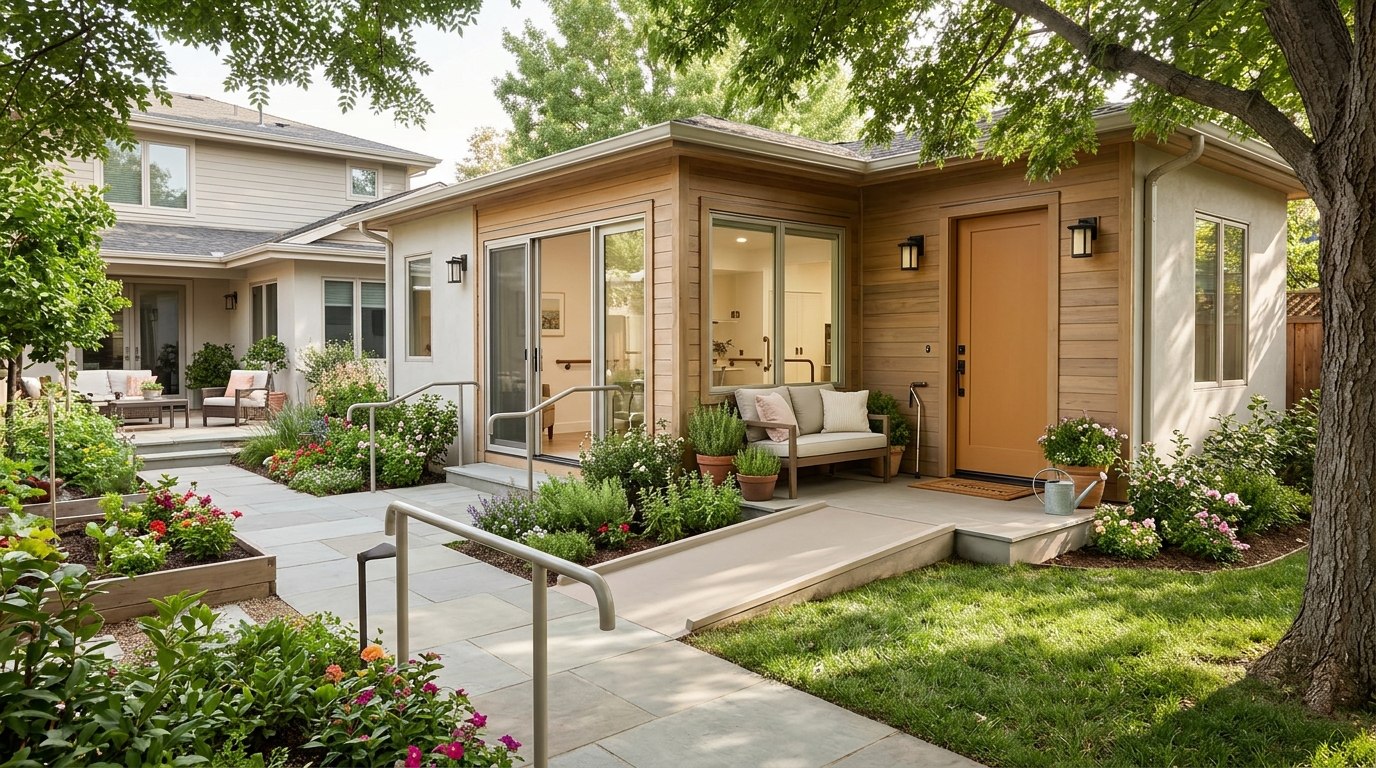
An ADU for aging parents works best when the family settles the human questions before the design: who pays and who owns the unit, what kind of help the parent will need now and later, when to build relative to their health, and how both households keep their privacy. The floor plan follows from those answers.
This guide covers the planning side of the project: the conversations, the money and ownership questions, care logistics, siting and what happens to the unit years from now. Accessible design gets only a brief mention here, because it deserves its own detailed treatment. If you are still deciding whether an ADU is the right move at all, our honest list of ADU pros and cons is a good first read.
Start With a Family Conversation, Not a Floor Plan
The parent is the person whose life changes most, and they should be part of the decision from the first discussion. Moving into a cottage behind a son’s or daughter’s house usually means leaving a longtime home, neighbors and sometimes a familiar doctor. Some parents welcome that; others agree out of duty and regret it later.
Siblings belong in the conversation too, even if they live far away. A brother who expects to share future caregiving, or a sister who wonders whether the project uses money that would otherwise be divided among the children, will have opinions. Raise them before the foundation is poured.
Questions Worth Answering Together
What does the parent want their daily life to look like in five years?
Which help will the family give, and which will come from outside caregivers?
Who will contribute money, and is each contribution a gift, a loan or a share in the property?
What happens if the parent needs more care than the household can provide?
What will the unit become when the parent no longer lives there?
A one-page written summary that everyone has read prevents a surprising number of later disagreements.
Who Pays, Who Owns and How to Write It Down
In most families the ADU is built on property owned by the adult child, while the parent contributes in some form, often from the sale of their own home. That arrangement is common and workable, but it needs to be described clearly. Money a parent puts into a building they do not own can be treated as a gift, as a loan to be repaid, or as an ownership interest, and each of those choices has different consequences for taxes, inheritance and the parent’s own finances.
Some families split the cost differently: the homeowner finances the construction and the parent pays a monthly amount that helps cover it. Our overview of the ways homeowners pay for an ADU explains the loan options, and the wider family dynamics of these projects are explored in what an ADU for a relative returns emotionally and financially.
Questions to Take to an Elder-Law Attorney
Several issues around a parent’s move have legal and benefit consequences that vary with each family’s circumstances. United Signature builds ADUs; it does not give legal or benefits advice, and neither does this article. An elder-law attorney, and often a tax professional, should review the plan before any money changes hands.
Useful questions to bring to that meeting include the following.
Could the parent’s contribution to construction affect their eligibility for long-term care benefits, including Medicaid, in the future?
How should a contribution be documented so the parent’s intent is clear?
How does the arrangement interact with the parent’s will and with what each sibling eventually inherits?
Are powers of attorney and health care directives in place so someone can act if the parent cannot?
What happens to the parent’s contribution if the property is sold?
Timing the Project Around a Parent’s Health
An ADU takes most of a year from first design meeting to move-in, and often longer when the lot is complicated; our realistic ADU timeline shows where those months go. That lead time is the main reason to start before help is urgently needed. Families who wait for a fall or a diagnosis often end up arranging a temporary solution first, then moving the parent a second time when the cottage is ready.
Building while the parent is still independent has another benefit: they can take part in choosing finishes, arranging their furniture and settling into the neighborhood while the move feels like their own choice. If health is already changing quickly, ask early about the shortest realistic path, such as converting existing space rather than building new, and plan a bridge arrangement for the months in between.
Coordinate any sale of the parent’s current home with the build schedule, so they are neither left without a place to live nor holding up a contribution the project depends on.
Care Logistics: Who Does What Each Day
Proximity does not organize care by itself. Agree on which tasks the family covers, such as meals, medication reminders, rides to appointments, laundry or yard work, and which may need an outside caregiver as needs grow. Family caregivers burn out when every task falls on one person by default.
In-home aides need a place to park and a simple way to get in. Emergency responders need to find the unit quickly from the street, so the path, lighting and signage should make the cottage easy to locate. A shared key arrangement, a call button or a simple intercom between the two homes can offer reassurance without constant check-ins.
Plan for the family caregiver’s rest too: a sibling who takes over one weekend a month, or a respite service, keeps the arrangement sustainable for years.
Privacy and Independence for Both Households
A parent living across the yard is still an adult with their own routines, visitors and preferences, and the household in the main house still needs evenings to itself. Families who handle this well usually agree on a few simple habits: knocking rather than walking in, a regular shared dinner rather than daily obligations, and clear expectations about grandchildren dropping by.
Let the parent furnish and run their own home. Their own furniture and kitchen tools make the unit feel like their place rather than a guest room, and paying a share of utilities, if they wish, often matters more to their independence than the amount.
Where the Cottage Should Sit on the Lot
Siting decides how close the two households feel. A unit within sight of the main kitchen window, connected by a short, level, well-lit path, lets family members check in naturally. Placing the entry where a car can pull up close helps with groceries, wheelchairs and medical transport.
A cottage tucked against the back fence feels more private but makes every trip longer in the rain and the dark. On some properties an attached unit or a converted lower level keeps a parent even closer, while a detached cottage gives both sides more separation; zoning, utilities and the yard’s slope will narrow the options.
On design itself, a few decisions should be on the table from the first meeting: a single level, a step-free entry, a bedroom close to the bathroom and a shower without a curb. If a live-in caregiver may be needed later, a second bedroom is worth considering, and the trade-offs of that layout are covered in our guide to planning a two-bedroom ADU.
What the Unit Becomes After a Parent Moves On
Most ADUs built for a parent outlive that use. A parent may move to assisted living or pass away, and the family then decides whether the cottage becomes a rental, a home for another relative, a guest suite or an office. Talking about this at the start is not morbid; it shapes decisions such as a separate meter, in-unit laundry and a private entrance that keep later options open.
Designing for that flexibility is a theme of our article on an ADU that serves family, renters and guests. Give the transition some emotional room as well. Many families leave it empty for a while before deciding.
Taking the First Practical Step
Once the family agrees on the basics, the next step is a look at what your lot and budget allow. Browse United Signature’s ADU and DADU packages to see the size categories, from compact single-level units to homes with room for a caregiver, then bring your family’s answers to a design conversation so the unit is planned around the people who will live in it.
FAQ
Can a parent pay for part of the ADU with proceeds from selling their house?
Yes, and many do. Decide in writing whether the money is a gift, a loan or an ownership share, and have an elder-law attorney and a tax professional review the arrangement before the funds are transferred.
Should we build before our parent actually needs day-to-day help?
Usually that is the better path. Construction takes months, and a parent who moves while still independent adjusts more easily and can help shape their new home.
Is an attached unit or a backyard cottage better for a parent who needs frequent help?
An attached unit keeps help a few steps away and suits parents who need regular assistance. A detached cottage gives more privacy to both households and works well while the parent is largely independent. The lot and the parent’s likely needs over the next several years decide.
Will an ADU for my parent affect their eligibility for Medicaid or other benefits?
It can depend on how the money is contributed and documented, and the rules are specific to each situation. Ask an elder-law attorney before your parent transfers money or property.
Can we rent out the unit once our parent no longer lives there?
Yes. Washington does not require the owner to live on the property, so the unit can become a long-term rental, subject to your city’s rental rules and your lender’s and insurer’s terms.