

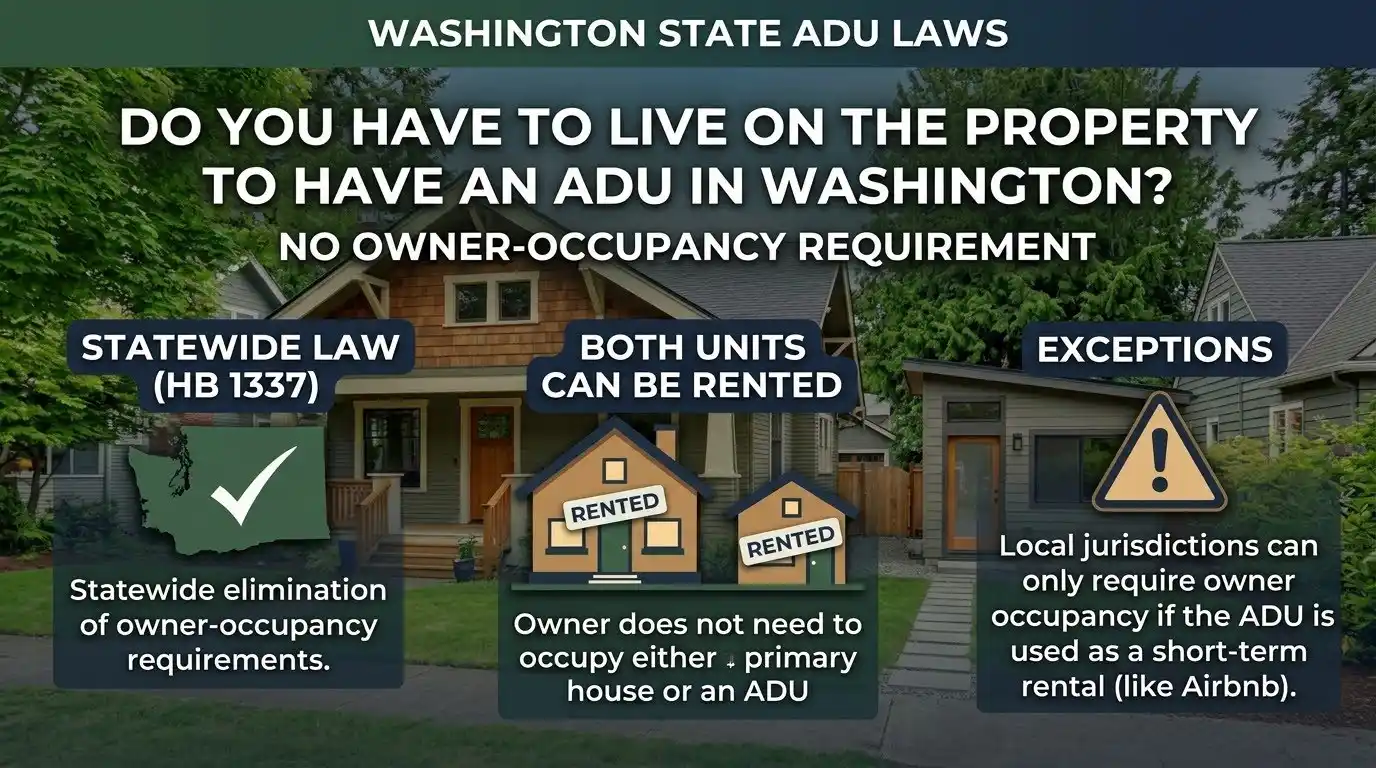
No. Under RCW 36.70A.681, cities and counties may not require the owner of a lot with an accessory dwelling unit to live in the ADU or any other unit on that lot. You can live in either unit, rent both, or not live there at all. The main exception involves short-term rentals.
That answers the zoning question, but it is not the whole picture. Older properties may still carry recorded owner-occupancy covenants, some cities attach on-site conditions to vacation rentals, and your mortgage and insurance policy have their own expectations about who lives where. This guide walks through each layer so you know what actually limits an off-site owner.
What Washington Law Says About Living on Site
The rule comes from HB 1337, adopted in 2023 and codified in RCW 36.70A.681. In plain terms, a city or county may not require the owner to reside in or occupy the ADU or another housing unit on the same lot. Municipal Research and Services Center (MRSC) summarizes it the same way: a local government may not require owner occupancy for the principal unit or for ADUs.
The statute also defines “owner” as any person with at least 50 percent ownership in the property, a definition that mattered when owner-occupancy rules were common. These standards apply to residential lots inside urban growth areas, which covers nearly every city lot in the Puget Sound region.
Why So Many Cities Used to Require It
For decades, owner occupancy was a standard condition of ADU approval across Washington. The owner had to live in either the main house or the accessory unit, and the requirement was often recorded against the property so it would bind future buyers. The logic was that an owner on site would keep the ADU secondary to the house and manage tenants closely.
Seattle dropped the condition in its 2019 ADU legislation, and several other cities followed before the state acted. Older codes elsewhere, including Lynnwood’s before its 2025 rewrite, still required it until HB 1337 made the removal statewide. Copies of those outdated codes still circulate online, so check the date on anything you read.
Old Owner-Occupancy Covenants That Still Appear on Title
When Seattle required owner occupancy, owners signed a covenant, had it notarized and recorded it with King County so it ran with the land. The rule behind it is gone, but a recorded document does not erase itself. It can still show up in a title report when you refinance or sell, and buyers or lenders may ask about it.
Seattle publishes a form called “Release of Owner Occupancy Covenant for ADUs” on the SDCI accessory dwelling unit page. If your title shows one of these covenants, download the release, follow its instructions for signatures and recording, and keep a copy of the recorded release with your property records. Other cities that once recorded similar covenants may have their own release process, so ask the planning department before assuming one exists.
Where Nightly Rentals Change the Answer
Washington leaves cities free to limit vacation-style rentals of ADUs, meaning stays of under 30 nights in a row. The Washington Department of Commerce reads this as the one place an on-site requirement can survive: a city may not require the owner to occupy the property, except if the ADU is used as a short-term rental.
The City of Snohomish is a clear example. Its code requires the property owner to reside on site if any ADU on the lot is used as a short-term rental. Seattle handles nightly rentals through a separate licensing system with limits of its own. Anyone planning a guest suite should treat those local conditions as part of the occupancy question.
What Lenders Expect When You Rent Both Units
Zoning may not care where you live, but your loan documents might. Many mortgages for a primary residence include an occupancy clause requiring the borrower to live in the home for an initial period. Moving out and renting both units can conflict with that clause, so read your note and talk to your lender before you change how the property is used.
Financing a new ADU on a property you do not occupy is also treated differently. Lenders generally view non-owner-occupied property as investment property, which can change eligibility, required equity and pricing. If you plan to live off site, say so when you shop for financing.
Insurance When the Owner Lives Elsewhere
A standard homeowner’s policy assumes the owner lives in the home. Once both units are rented, most owners need a landlord or dwelling policy that covers rental use, liability to tenants and loss of rental income. Even when you live on site and rent only the ADU, tell your insurer about the tenant and the new structure, since an unreported rental can complicate a claim.
Arrangements the Rule Now Allows
Without an occupancy requirement, owners use ADUs in ways that used to be off the table. Some rent both units as long-term rentals. Some move into the cottage and rent the larger house. Some house a relative in one unit while the other is rented or sits empty between family visits. Others relocate for work and keep the whole property.
Each option has different tax, insurance and management consequences, but none of them depends on a city’s permission. For rent-setting and tenant questions, see our guides on how to set rent for a Seattle ADU and using an ADU for rental income.
A Checklist Before You Move Out or Buy as an Investor
Review the title report for recorded owner-occupancy covenants and release any that apply.
Look up local licensing and residency conditions if you plan nightly or weekly guest stays.
Check any HOA declarations or private covenants, which are a separate legal layer from zoning.
Confirm your mortgage’s occupancy terms with your lender.
Update your insurance to match how each unit is used.
Register the rentals if your city requires rental registration or licensing.
If you have not built yet, also confirm how many units your lot can take; our article on how many ADUs fit on one lot covers the statewide rule. A free feasibility report for your address shows what your parcel allows before you plan around renting both units, and our write-up on what the lot feasibility report covers explains what you receive.
FAQ
Can I buy a house with an ADU and rent out both units?
From a zoning standpoint, yes. Washington cities cannot require an owner to live on the property. Your financing and insurance will need to reflect that both units are rentals.
Who counts as the “owner” under Washington’s ADU law?
The statute defines an owner as any person who holds at least 50 percent ownership in the property where the ADU is located.
Does an old owner-occupancy covenant disappear on its own?
No. Even though the rule behind it no longer applies, the recorded document stays in the property’s title history until a release is recorded. Seattle provides a release form for its covenants.
Do I need to tell my mortgage lender before I move out and rent both units?
Read your loan documents first. Many primary-residence mortgages include occupancy terms, and changing the property’s use without checking can create problems with the loan.
Can I leave the ADU empty or use it only for visiting family?
Yes. Washington’s ADU rules do not require the unit to be rented, and keeping it for family or guests is allowed. Nightly rentals to the public are a different matter and fall under short-term rental rules.