

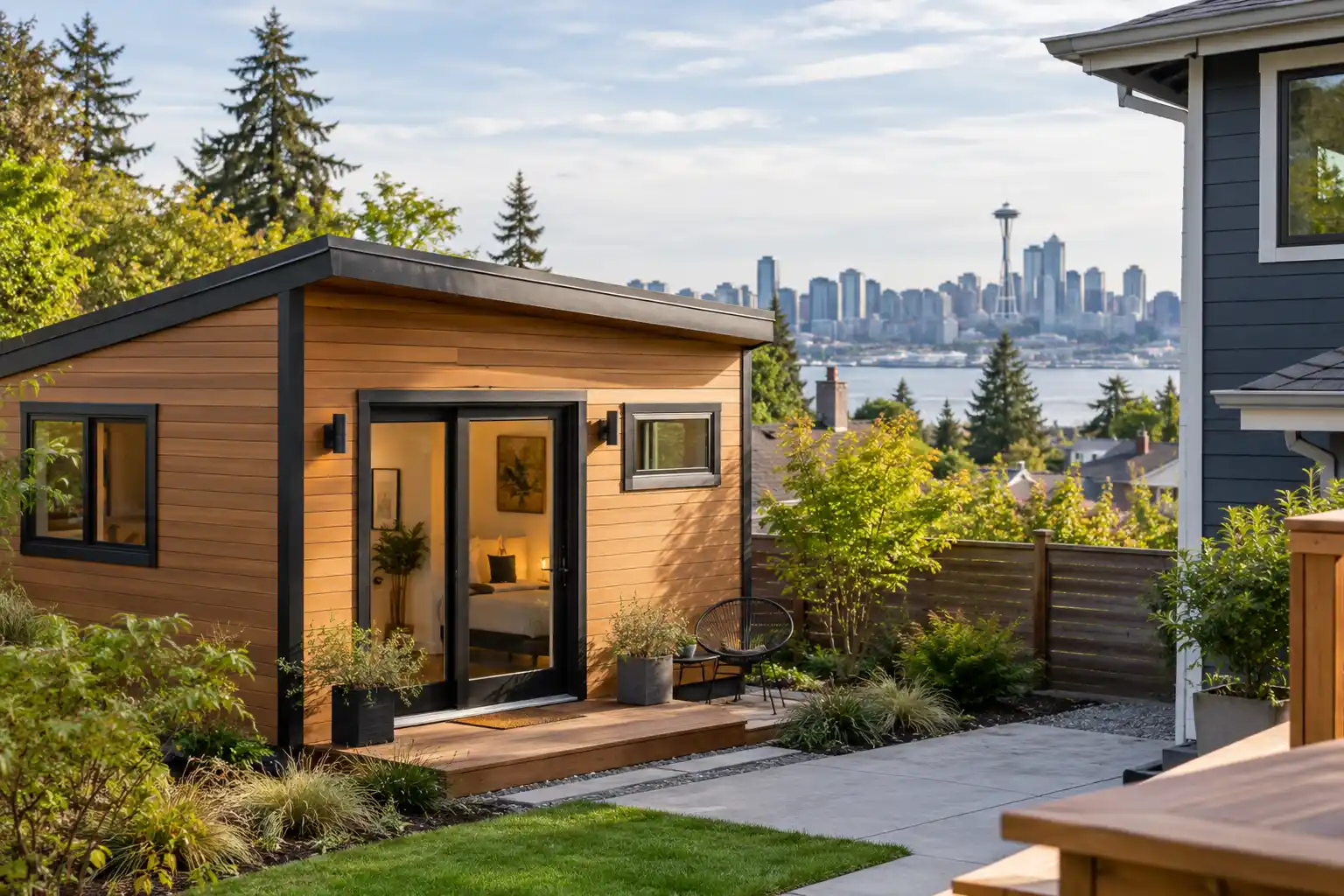
A permitted Seattle ADU can be rented to guests for fewer than 30 nights at a time, but the owner needs a Seattle business license tax certificate and a short-term rental operator license, can generally operate only a primary residence plus one other unit, must show the license number on every listing, and must follow state tax, insurance and guest-safety rules.
This guide explains how those requirements apply to backyard cottages and in-house ADUs, and how they shape an ADU planned for guests. It reflects city and state rules as of October 2026; confirm the current versions before you design or list.
What Seattle Treats as a Short-Term Rental
The city defines a short-term rental as a house, condominium or apartment, or part of one, rented for a fee for fewer than 30 consecutive nights. The land use rules are in Seattle Municipal Code 23.42.060, and the licensing rules are in SMC chapter 6.600, which took effect on January 1, 2019.
Short-term rentals are allowed in most structures established as dwelling units. They are not allowed in garages, RVs, tents, boats and other spaces that are not dwelling units. For an ADU owner, that means the unit has to be a legal, permitted dwelling before it can host paying guests. A garage or basement that was converted without permits does not qualify until its use has been legally established.
The Two-Unit Limit and How It Plays Out on an ADU Lot
According to the city’s licensing guidance, most operators may run two short-term rental units: their primary residence and one additional unit they do not live in. Limited exceptions apply to operators who were legally running short-term rentals before September 30, 2017. The city asks applicants for documents that show which address is their primary residence.
Because Seattle now allows up to two ADUs on most residential lots, the limit matters more than it used to. Here is how it typically works in common situations.
You Live in the Main House and Host Guests in the Cottage
This is the most common setup. The house is your primary residence and the backyard cottage is your one additional unit. You could also host guests in part of the home you live in, since your primary residence counts as one of the two.
A Lot With a House and Two ADUs
If you live on site, only one of the two ADUs can typically serve as your additional short-term rental. The other would go to a long-term tenant, a family member or your own use. Our article on how many ADUs one lot can hold explains the combinations, and the guide to setting rent for a Seattle ADU covers pricing the unit that is leased long term.
You Live Somewhere Else
Washington no longer lets cities require the owner to live on the property, as covered in our article on owner-occupancy rules for ADUs. An owner who lives elsewhere can still license one unit on the ADU property as the additional unit, but that uses the slot. A second short-term rental anywhere else in the city, other than the owner’s own primary residence, would exceed the limit.
Licenses and Registrations to Line Up Before the First Booking
Several separate registrations apply, and the order matters.
Seattle business license tax certificate: required before you can apply for the short-term rental license.
Short-term rental operator license: issued by the city’s Finance and Administrative Services department through the Seattle Services Portal. The city charges a fee for each unit, and the license must be renewed every year. The application lists ADU and DADU as property types and asks whether each unit is your primary address.
Rental Registration and Inspection Ordinance (RRIO): if the short-term rental is not inside the home you live in, such as a backyard cottage or a separate basement apartment, it must be registered with RRIO before it is listed. The operator license application asks for the RRIO number of any unit that is not your primary residence.
State registration: the Washington Department of Revenue may require you to register a business if you advertise a unit, hire a property manager or book stays of fewer than 30 days.
You may hire a property manager to list and run the unit, but the city requires the operator license to be in the owner’s name.
Your License Number Belongs on Every Listing
Seattle requires the operator license number to appear on every listing that advertises or offers the unit, on every platform you use. City licenses follow a set format that begins with STR-OPLI. Operating without a regulatory license can bring a penalty for the first violation and a larger one for each later one, according to the city.
Guest Safety, Contact and Insurance Requirements
Washington’s short-term rental law, RCW 64.37, adds requirements that apply statewide. Operators must give guests contact information for someone available to respond during the stay, and the unit must meet state building code standards for carbon monoxide alarms. The following must be posted conspicuously inside the unit:
The street address.
Emergency contact information for police, fire and medical services.
A floor plan showing fire exits and escape routes.
The maximum occupancy.
The operator’s contact information.
Seattle’s own operating standards include posting basic safety information and providing a local contact number for guests.
On insurance, state law requires the operator to carry primary liability insurance at the minimum level set by state law covering the unit, or to book every stay through a platform that provides equal or greater primary liability coverage. Ask your homeowner’s insurer separately how hosting affects your existing policy, since a standard policy may not cover commercial guest use.
Taxes on Nightly Stays
Under RCW 64.37.020, operators must pay all applicable local, state and federal taxes unless the platform collects and remits them on the operator’s behalf. According to the Department of Revenue, nightly rental charges are generally subject to retail sales tax and, depending on location, lodging and convention and trade center taxes, plus business and occupation tax. Check which of these your platform handles, and ask a tax professional about income tax.
Designing an ADU That Works for Guests
If nightly rentals are part of the plan, a few design decisions make the unit easier to run and to keep compliant.
A separate, well-lit path and entry that guests can find at night without walking past the main house’s windows.
Keyless entry, so check-ins do not depend on someone being home.
Clear exit routes and windows that make the required floor plan simple to read.
Smoke and carbon monoxide alarms placed and wired during construction rather than added later.
A lockable owner’s closet for linens, supplies and personal items.
A stacked washer and dryer, because frequent turnovers mean frequent laundry.
Durable flooring and finishes that tolerate heavy, varied use.
Sound separation from the main house, especially for attached units.
Guests often ask about parking, so decide early whether a space or a driveway spot will be offered.
Planning for a Switch Between Guests and Long-Term Tenants
Many owners host guests for a few years and later lease to a long-term tenant, or the reverse. A stay of 30 consecutive nights or more falls outside the city’s short-term definition and carries ordinary landlord-tenant obligations. A full kitchen, real storage and in-unit laundry let the same unit serve either use without remodeling. Seattle’s broader ADU and DADU rules set what you can build; flexibility decides how well it keeps working.
Before You List Your ADU
Confirm the unit is a permitted dwelling unit.
Get the Seattle business license tax certificate.
Register a detached or separate unit with RRIO.
Apply for the operator license and gather your primary-residence documents.
Arrange liability coverage that meets state law and review your homeowner’s policy.
Post the required safety information and alarm the unit for carbon monoxide.
Confirm which taxes your platform collects and register with the state if needed.
If you are still deciding whether your lot can take a unit at all, a no-cost lot feasibility report checks zoning, setbacks, slope and utilities for your address before you invest in a design meant for guests.
FAQ
Do I need a separate license for each short-term rental unit in Seattle?
The operator license covers your units, but the fee is charged per unit. Each unit you list, such as a room in your home and a backyard cottage, is included in the license and must be renewed every year.
Can a property manager hold the short-term rental license for me?
No. A property manager can list and manage the unit, but the city requires the operator license to be in the owner’s name.
Does a stay of exactly 30 nights count as a short-term rental?
No. Seattle’s definition covers stays of fewer than 30 consecutive nights. A booking of 30 nights or more falls outside the short-term rental rules and is treated as an ordinary rental.
Can I host guests in an unpermitted basement apartment?
Not legally. Short-term rentals are allowed only in spaces established as dwelling units, so an unpermitted unit has to be legalized first. That process requires a permit to establish the use and often building upgrades.
What happens if I list my ADU without a license?
The city can issue penalties for violations, and repeat violations cost more than the first. Because the license number must appear on every listing, a listing without one stands out quickly, so get licensed before taking the first booking.