

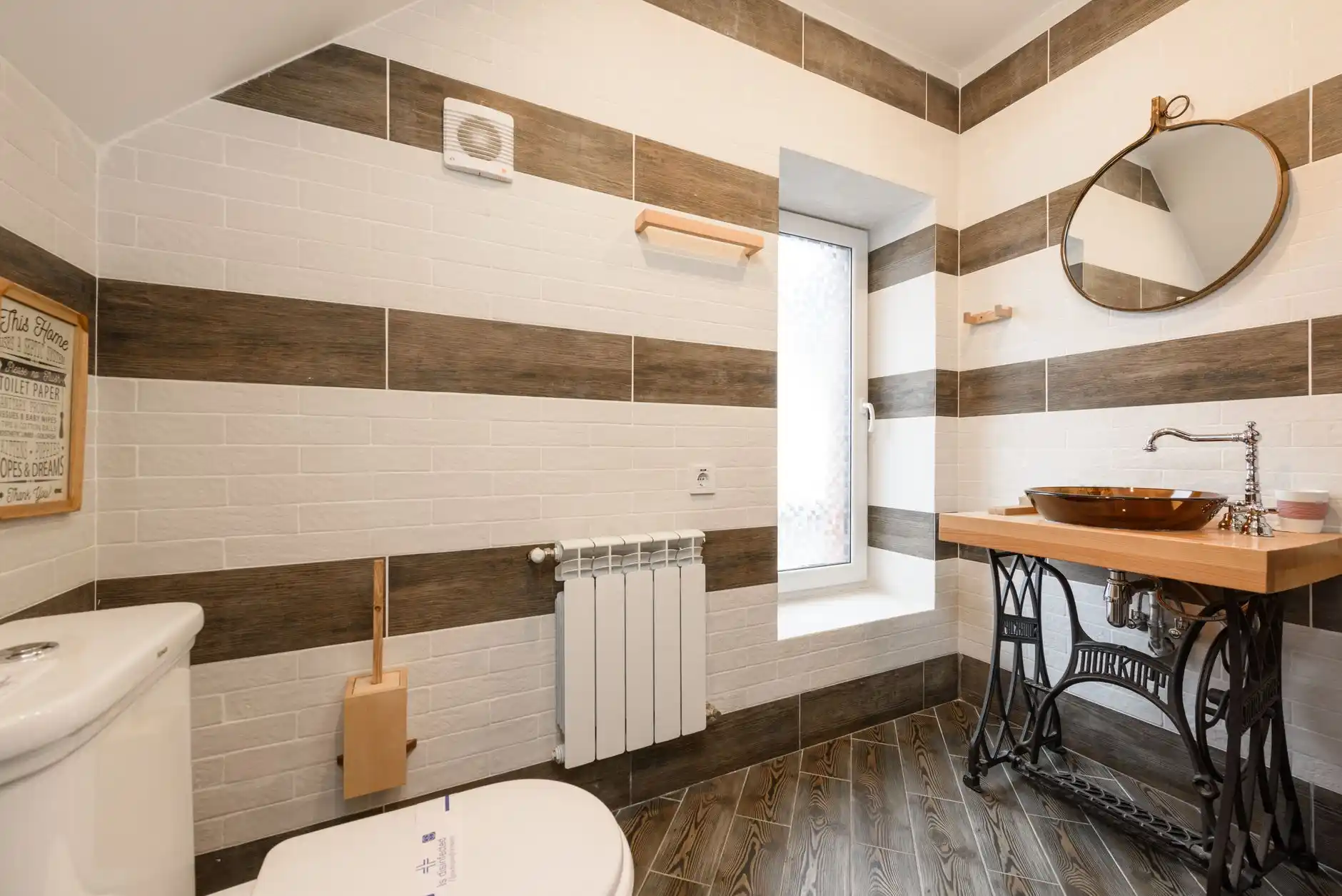
A bathroom fan is not useful because it has a large CFM number printed on the box.
It is useful when the installed system actually removes moisture from the bathroom.
That depends on:
– fan capacity;
– duct size;
– duct length;
– elbows;
– exterior termination;
– make-up air;
– installation quality;
– noise;
– and whether people actually use it.
A small quiet fan with a good duct can outperform a large fan connected to a long restrictive route.
Bathroom ventilation should therefore be designed as a system.
Why Bathrooms Need Mechanical Ventilation
Showers and baths create significant moisture.
Without effective removal, that moisture can contribute to:
– condensation;
– peeling finishes;
– mildew;
– mold growth;
– damaged window trim;
– and long-term moisture in wall or ceiling assemblies.
Opening a bathroom window can help under some conditions.
It is not a reliable substitute for a properly designed mechanical ventilation system when code requires one.
A remodel is the best time to improve ventilation because walls and ceilings may already be open.
CFM: What Does It Mean?
CFM means cubic feet per minute.
It measures air volume moved by the fan.
A larger bathroom generally needs more airflow than a tiny powder room.
But fan selection should follow the applicable mechanical code, room configuration, and product performance rather than a single internet formula.
The current Seattle Mechanical Code and residential code path should be checked for the specific project.
Avoid hard-coding an old CFM rule into the design without verifying the adopted code.
Fan Ratings Are Not the Whole Story
A fan may be rated for a certain airflow under standardized conditions.
Actual installed airflow can be lower if the duct system is restrictive.
Problems include:
– undersized duct;
– long duct run;
– several sharp elbows;
– crushed flexible duct;
– dirty termination;
– and poor roof or wall cap.
The installer should follow the fan manufacturer’s duct requirements.
A good design uses the shortest practical route to the exterior.
Vent to the Exterior
Bathroom exhaust should terminate outdoors.
Do not discharge moist bathroom air into:
– attic;
– crawlspace;
– wall cavity;
– or another interior space.
That simply moves the moisture problem.
The exterior termination should be detailed so it resists rain entry and pests while allowing proper airflow.
Roof and wall penetrations need correct flashing.
A ventilation upgrade should not create a new leak.
Fan Location
Place the fan where it captures moisture effectively.
In a bathroom with a shower, locate the exhaust close enough to the wet zone to remove steam efficiently while respecting electrical and manufacturer requirements for the location.
Large bathrooms may use multiple pickup points or a different fan strategy.
A fan installed across the room from the shower behind a closed door may perform poorly even if its CFM rating looks adequate.
Room layout matters.
Noise: Sones
Noise strongly affects whether people use the fan.
A loud fan is often switched off too early.
A quiet fan can run long enough to remove residual moisture after showering.
Fan sound is commonly rated in sones.
Lower values generally indicate quieter operation.
Do not select only by CFM.
Compare sound performance and installed duct design.
Timers and Humidity Controls
A timer can be one of the best ventilation upgrades.
The user can leave the fan running after the shower without remembering to return later.
Humidity-sensing controls can also help automate operation.
Control strategy should match household preference.
Some people prefer manual control with a countdown timer.
Others want automatic humidity response.
The electrical plan should be coordinated before tile and mirrors are installed.
How Long Should the Fan Run?
The exact time depends on room moisture, airflow, shower use, and outdoor conditions.
A practical goal is to run the fan long enough that visible condensation and elevated moisture dissipate.
A timer can make twenty- or thirty-minute post-shower operation easy where appropriate.
Do not treat a fixed number as a universal code requirement.
The system should be evaluated by performance.
Heated Floors Do Not Replace Ventilation
Warm tile can make a bathroom comfortable.
It does not remove water vapor.
The Heated Bathroom Floors article should be viewed as a comfort system.
Ventilation remains necessary for moisture control.
The same applies to towel warmers.
Heat and exhaust solve different problems.
Shower Size Matters
A large steam-producing shower, multiple showerheads, or long hot showers can create more moisture than a small conventional shower.
The fan strategy should consider real use.
If a bathroom includes a steam shower, ventilation and enclosure design require even more specific planning.
Do not use a standard bath-fan assumption for specialty steam equipment.

Natural Ventilation
A window can provide useful fresh air.
Seattle weather and homeowner habits make it unreliable as the only moisture-control strategy.
People do not always open windows during cold weather.
A window also may not remove moisture quickly from a large shower area.
Mechanical ventilation provides predictable airflow independent of whether someone remembers to open the sash.
Duct Through the Roof or Wall?
Both can work when designed correctly.
The best route depends on:
– bathroom location;
– attic access;
– exterior walls;
– roof structure;
– duct length;
– and weatherproofing.
A wall termination can create a short route.
A roof termination may be more practical for interior bathrooms.
Do not select the route only to make installation easiest.
Consider long-term water management and serviceability.
Permits in Seattle
Seattle mechanical permits cover regulated venting and mechanical work.
The exact permit path depends on the project.
Electrical work for new fan wiring or controls can also require an electrical permit.
Use Seattle Remodel Permit Checklist for coordination.
The fan should be part of the remodel permit strategy rather than installed informally after final inspection planning.
Ventilation and Mold Prevention
Ventilation helps control indoor moisture.
It does not fix active leaks.
If the bathroom has:
– failed shower waterproofing;
– leaking plumbing;
– roof leak;
– or water entering around a window,
the source must be repaired.
A larger fan cannot dry a wall that is continuously leaking from inside.
Use Water Damage Restoration Cost if the project has already experienced substantial moisture damage.
A Practical Fan-Selection Process
1. Measure the bathroom.
2. Identify shower, tub, toilet room, and door configuration.
3. Check current code airflow requirements.
4. Select a quality fan with appropriate capacity.
5. Plan the shortest practical duct route.
6. Size duct per manufacturer requirements.
7. Choose a quiet product.
8. Add timer or humidity control if useful.
9. Vent outdoors with a proper termination.
10. Verify actual operation after installation.
The best bathroom fan is the one people barely notice because it quietly does its job.
FAQ
How many CFM should my bathroom fan have?
The required airflow depends on room and code requirements. Use the current adopted code and fan manufacturer’s performance rather than one universal rule.
Can a bathroom fan be too powerful?
An oversized fan can add noise and unnecessary air movement, and broader pressure effects may need consideration. Correct sizing is better than simply choosing the largest fan.
Should a bathroom fan vent into the attic?
No. Moist air should be exhausted outdoors through an appropriate termination.
Is a quiet bathroom fan worth it?
Yes. A fan that is comfortable to leave running is more likely to be used long enough to control moisture.
Do I need a fan if the bathroom has a window?
A window may not eliminate mechanical-ventilation requirements or provide reliable moisture control. Verify the current code path for the project.