

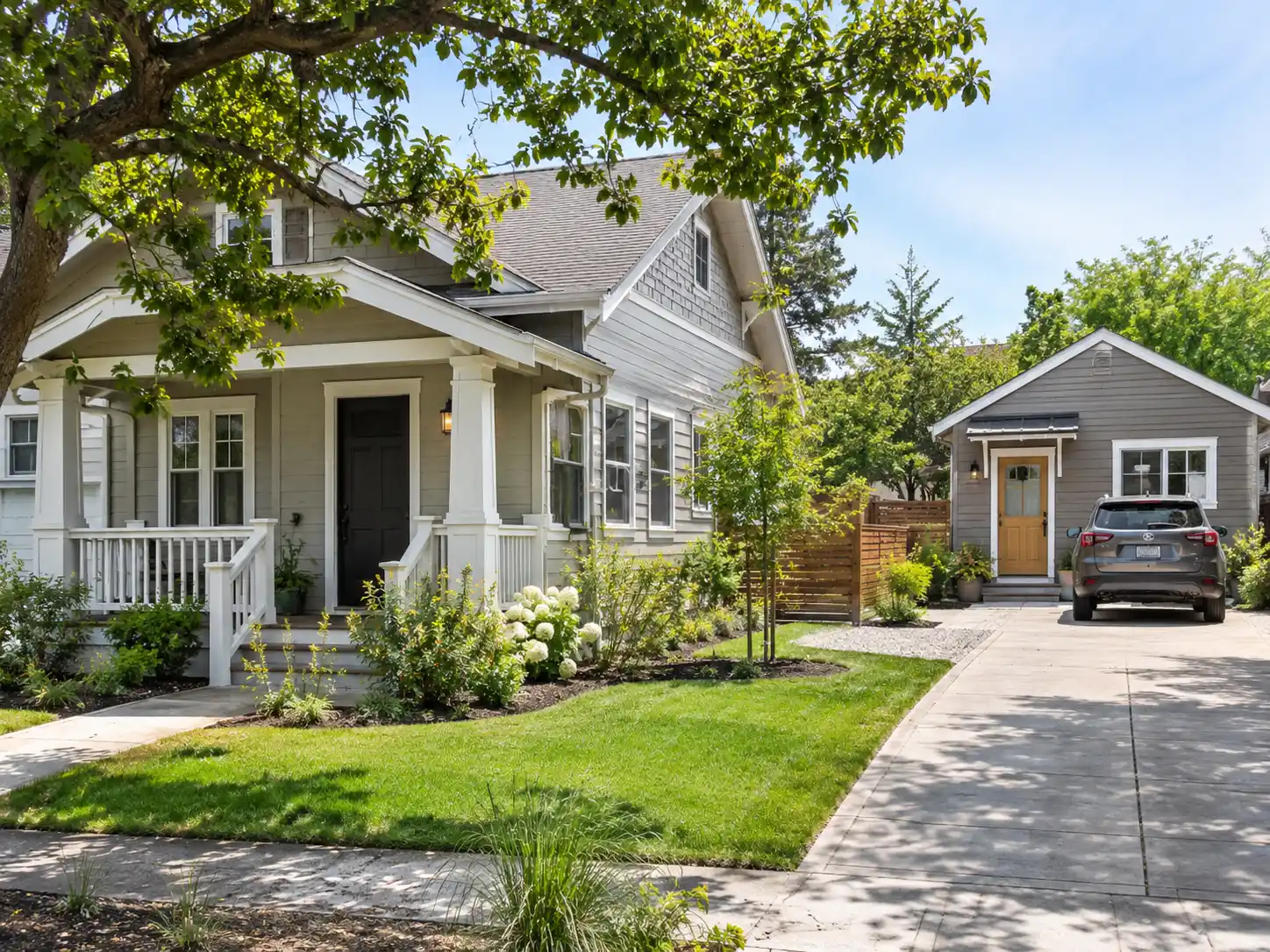
Often not. Near a major transit stop, Washington cities cannot require an ADU to have off-street parking. Elsewhere a city may still ask for it, but no more than one space per unit on lots under 6,000 square feet and two on larger lots, and many Puget Sound cities require none.
Parking used to be one of the quiet reasons backyard projects died: no room for a new space, or a garage that could not be converted without replacing the stall it held. This guide explains the state rule, what counts as a major transit stop, the two exceptions, and what happens to the parking you already have.
The State Parking Rule, Line by Line
Subsection (2) of RCW 36.70A.681, part of the HB 1337 package, holds the parking limits, which reach lots inside urban growth areas. Under it, a covered city or county may not:
Make off-street parking a condition of an ADU permit where the lot lies no more than half a mile, measured as walking distance, from a major transit stop.
Ask for more than one off-street space per ADU on lots smaller than 6,000 square feet.
Ask for more than two off-street spaces per ADU on lots larger than 6,000 square feet.
Lot size is measured before any zero lot line subdivision or lot split, so dividing the land later does not change which cap applied. The caps are maximums, and a city can always require less.
What Counts as a Major Transit Stop
State law defines a major transit stop as any of the following.
A stop on a high-capacity transportation system funded or expanded under chapter 81.104 RCW, the state framework for regional high-capacity transit.
A commuter rail stop.
A stop on a rail or fixed guideway system, including transitways.
A stop on a bus rapid transit route or a route that runs on high-occupancy vehicle lanes.
A stop for a bus or other transit mode with fixed-route service at intervals of at least every fifteen minutes for at least five hours during weekday peak hours.
In Puget Sound terms, that usually includes light rail stations, Sounder stations and bus rapid transit stops, plus some ordinary bus stops on frequent routes. The last category is the one that surprises people, because a busy local bus line can qualify a lot that is nowhere near a train.
Half a Mile on Foot, Not on a Map
The distance is walking distance, which is longer than a straight line. A freeway, a ravine or a long block without a cut-through can push a lot outside the half mile even when a station is visible from the yard. Many cities publish a map of qualifying stops and walksheds, and frequent bus service can change as routes are redesigned, so ask which map the reviewer uses and as of what date.
Lots Beyond the Half Mile
Away from frequent transit, the caps apply per ADU. On a 5,000-square-foot lot adding two ADUs, a city could require at most one space for each unit; on an 8,000-square-foot lot, at most two for each.
In practice, many cities ask for less or nothing. Everett’s ADU guidance waives off-street parking for any dwelling below 1,200 square feet, Bothell has no parking minimum for ADUs anywhere in the city, and Seattle does not require parking for ADUs at all. Others still require a space outside transit areas, so the local code decides the answer once a lot falls beyond the walkshed.
Two Exceptions That Bring Back Local Rules
The state caps do not apply in two situations.
A certified safety study. A city can submit an empirical study, prepared by a credentialed transportation or land use planning expert, showing that the caps would make a location significantly less safe for drivers, passengers, pedestrians or bicyclists than parking rules for the same number of detached houses. The caps fall away only where the Department of Commerce reviews the study and certifies that finding.
Near a major airport. The caps do not apply to portions of cities within one mile of a commercial airport in Washington with at least 9,000,000 annual enplanements. Commerce’s guidance identifies Sea-Tac as the airport this covers, so lots close to it follow local parking rules.
A Newer State Law Also Limits Parking Minimums
In 2025 the Legislature passed a broader parking reform, ESSB 5184, which limits how much parking cities may require for housing generally, including no minimum for residences under 1,200 square feet. It is phased in on a schedule tied to city size, and Commerce has been preparing guidance on how it fits with the existing ADU and middle housing rules. Until your city updates its code, apply the ADU rule above and ask the planning desk whether the newer law has changed anything locally.
When the ADU Takes the Driveway or the Garage
Converting a garage or building over a driveway can eliminate parking the main house already had. The state’s conversion protection covers setbacks and lot coverage, not parking, so whether the house’s lost space must be replaced depends on what the local code requires for the house itself.
Commerce’s guidance recommends that cities allow any replacement parking for the house and the ADU on a driveway or on the street where possible, and it mentions pervious paving as one way to offset added parking surfaces. Where a city still requires a space for the house, a short driveway apron or a tandem space is often enough. Our article on turning a garage into living space covers the design side of a conversion.
Parking You Add by Choice
Even where nothing is required, an off-street space can make a rental easier to lease or suit a family member who drives. Before adding one, weigh what it uses: a new curb cut usually needs a permit from the city’s transportation department, paving adds impervious surface that drainage rules may count, and every parking pad takes footprint the ADU could have used. Our guide to setbacks and lot coverage explains how those surfaces and buildings share the same limits.
Confirming the Answer for Your Address
Start with your city’s ADU section and its parking table, then check the transit map for your walking distance to the nearest qualifying stop. City-by-city differences are summarized in our overview of HB 1337 across Puget Sound, and Seattle owners can see the full local picture in our Seattle ADU code guide. If you are weighing more than one unit, the parking math works alongside the rules in our two-ADU explainer. To have zoning, parking and access reviewed for your parcel in one pass, order a free lot feasibility report.
FAQ
Does on-street parking count toward a city’s ADU parking requirement?
Usually not, since required parking is typically off-street. Commerce recommends that cities accept replacement parking on the street where possible, so some local codes give credit for curb space.
Can a city require the ADU’s space to be covered or in a garage?
The state law limits how many spaces a city may require, not their form. Covered parking requirements are rare for ADUs, but read the local standards before assuming an open pad is enough.
If a nearby bus route loses frequency, does my lot lose the no-parking rule?
It can, because qualification depends on current service. Which date counts is a question of local procedure and vesting, so confirm the status when you apply, not when you first sketch the project.
Are tandem spaces in a driveway accepted for ADU parking?
Many cities accept tandem spaces for houses and ADUs, though not all. Ask early, because a tandem layout on an existing driveway can avoid a new curb cut.
Does a required ADU parking space have to be paved?
Surfacing rules are local. Some cities accept gravel or pervious pavers, which also reduce stormwater runoff, while others require a hard surface; drainage rules may count either one toward impervious area.