

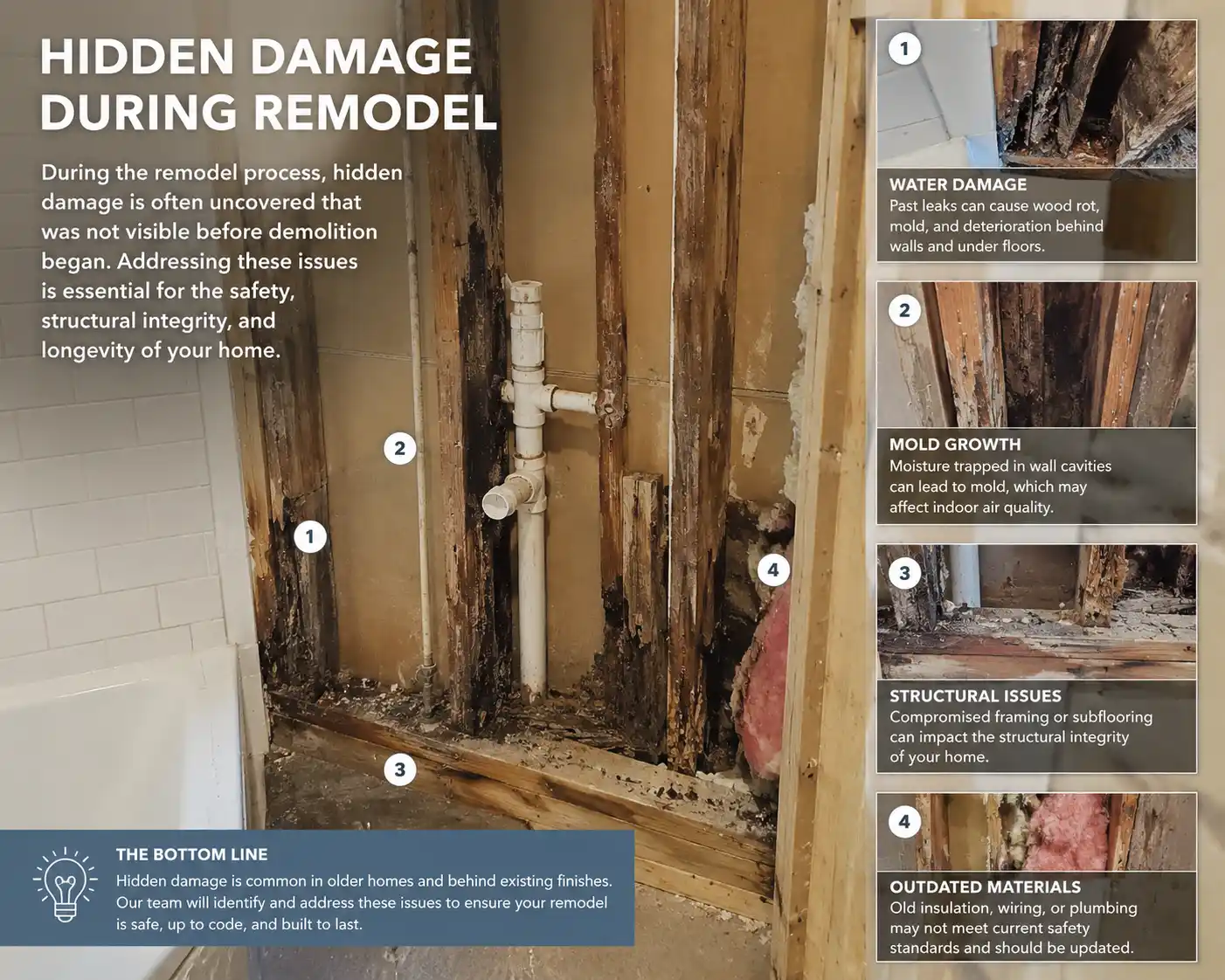
Demolition changes a remodel from assumptions to evidence.
Before a wall is opened, the project team can inspect, measure, research records, and look for warning signs.
It still cannot see everything.
Once drywall, flooring, cabinets, or siding are removed, the house may reveal water damage, rot, cut framing, old wiring, leaking plumbing, insect damage, previous unpermitted work, or structural conditions that were never visible during design.
A hidden condition does not automatically mean the project has gone wrong.
What happens next determines whether it becomes a controlled correction or an expensive crisis.

Step 1: Stop and Document the Condition
Do not immediately cover it.
Do not immediately demolish everything around it either.
Photograph the condition.
Record location.
Identify what materials are affected.
Determine whether the condition creates an immediate safety or water problem.
This documentation gives the homeowner, contractor, designer, engineer, and trades the same starting point.
It can also help distinguish pre-existing damage from damage caused during construction.
The risk categories in Hidden Problems in Older Seattle Homes That Can Change a Remodel Budget explain why older houses deserve more investigation and contingency.
Step 2: Identify the Source, Not Only the Damage
Rot is the result of moisture.
A stained subfloor is the result of water.
Corroded wiring may be the result of age, moisture, or improper installation.
Repairing the visible damage without fixing the source is incomplete.
Examples:
Rotten window framing.
Do not just replace the stud. Determine whether flashing, siding, sealant, or window installation allowed water in.
Damaged bathroom subfloor.
Determine whether the source was shower waterproofing, toilet leakage, plumbing, or another condition.
Wet basement wall.
Determine whether the cause is drainage, foundation seepage, plumbing, or condensation.
The source repair belongs in the corrective scope.
Step 3: Determine the Type of Professional Needed
Different hidden conditions require different expertise.
Structural damage:
Structural engineer or qualified structural professional may be needed.
Electrical:
Licensed electrical contractor.
Plumbing or gas:
Appropriately licensed plumbing professional.
Mold or contaminated materials:
Qualified mitigation or remediation professionals depending on condition.
Suspect asbestos or lead:
Appropriate hazardous-material investigation and regulated work practices.
Exterior water intrusion:
Contractor with building-envelope understanding, sometimes with additional specialist input.
The general rule is not to ask one trade to diagnose every building problem.
Step 4: Decide Whether the Current Work Can Continue Elsewhere
A hidden condition does not always stop the entire project.
If damage is isolated to one bathroom, work may continue in another area.
If the condition affects a central beam, main electrical service, active water leak, or project-wide system, more work may need to pause.
The contractor should update the critical path.
This is where a realistic project schedule matters.
The whole-house remodel timeline should include room for inspections, corrections, and concealed-condition decisions on complex older homes.
Step 5: Determine Whether the Design Must Change
Some damage can be repaired back to the planned condition.
Other discoveries change the design.
Example:
Demolition reveals that the wall planned for a simple opening carries loads differently than expected.
The engineer may change beam size or post location.
Another example:
The new shower was designed over a floor area with extensive joist damage.
The framing may need repair before the shower elevation can be confirmed.
The correct approach is to update the design first and finishes second.
Do not force the original drawing onto a building that has revealed different facts.

Step 6: Check Permit Implications
Corrective work may affect permits.
If the hidden condition requires structural changes, additional plumbing, electrical corrections, or a change from approved plans, the permit may need revision or additional authorization.
Seattle provides processes for permit revisions and additional work.
The contractor and design team should determine whether the correction fits the approved scope or needs formal revision.
Use the Seattle Remodel Permit Checklist for the main permit categories.
If the hidden condition reveals older undocumented construction, read What Happens If Unpermitted Work Is Discovered During a Remodel?.
Step 7: Price the Corrective Work Separately
The homeowner should be able to distinguish:
Original contract scope.
Hidden-condition corrective scope.
Owner-requested upgrade.
These are not the same thing.
Example:
Original scope:
Remove old bathroom and build new bathroom.
Hidden condition:
Replace 80 square feet of water-damaged subfloor and sister two damaged joists.
Owner upgrade:
Add heated floor and premium tile.
Keeping these categories separate creates a transparent budget.
Washington L&I recommends putting contract changes in writing.
A clear written change order should describe the added scope, price, and schedule effect before work proceeds except when immediate emergency action is necessary for safety or damage control.
Step 8: Use Contingency Deliberately
This is what contingency is for.
A reserve should absorb legitimate concealed-condition work without forcing the homeowner to abandon the entire project.
If the remodel has no reserve, every hidden problem becomes an emergency financial decision.
The planning method in How Much Contingency Should You Budget for a Home Remodel? is particularly relevant here.
After using contingency, update the remaining reserve.
Do not simply continue spending from an undefined pool.
Step 9: Repair Before Covering
This seems obvious.
Schedule pressure can make it tempting to close walls before every question is resolved.
Do not.
Affected framing should be repaired.
Wet assemblies should be dry.
Required inspections should occur.
Electrical or plumbing corrections should be complete.
The source of water should be addressed.
Then the wall can close.
A drywall crew arriving tomorrow is not a reason to conceal unresolved work today.
Common Hidden Damage: Rotten Framing
Rot usually appears where water has repeatedly entered.
Common locations:
– windows;
– exterior doors;
– deck ledgers;
– roof transitions;
– showers;
– tubs;
– toilet areas;
– and foundation-level framing.
Small localized damage may be straightforward.
Extensive decay in beams, joists, posts, or bearing walls may require structural design.
Do not judge structural significance by color alone.
Evaluate how much material has lost integrity and what load it carries.
Common Hidden Damage: Subfloor
Water-damaged subfloor can swell, delaminate, soften, or lose fastener holding.
The repair depends on material and extent.
Replacing a section may require temporarily removing plumbing fixtures, cabinets, or finish flooring.
If damage extends under walls, the work becomes more complicated.
The subfloor should be sound before tile, waterproofing, hardwood, or cabinetry is installed over it.
Common Hidden Damage: Old Wiring
Opening walls can reveal wiring that is older or more altered than expected.
The electrical contractor should determine whether the condition can remain, should be repaired locally, or makes broader replacement practical while access exists.
Do not bury obviously questionable wiring simply because it was “working before.”
A remodel creates an opportunity to improve systems while access is inexpensive.
Common Hidden Damage: Plumbing
Small plumbing leaks can remain hidden for years.
Once exposed, evaluate both the leak and surrounding piping.
One failed fitting does not automatically require a whole-house repipe.
But a leak discovered within broadly deteriorated piping may justify a larger conversation.
The decision should consider material, age, condition, accessibility, and long-term remodel plan.
Common Hidden Damage: Mold
Visible microbial growth should not be treated as a paint problem.
Stop the moisture source.
Determine the extent.
Use appropriate containment and remediation procedures for the conditions present.
Rebuild only after the assembly is ready.
The water-damage process in Water Damage Restoration Cost: What Affects the Final Repair Bill? explains why source correction, mitigation, and reconstruction are separate scopes.
Can Better Preconstruction Prevent Hidden Damage?
It can find some problems earlier.
Useful tools can include:
– moisture meters;
– infrared investigation where appropriate;
– sewer camera;
– electrical evaluation;
– structural review;
– permit research;
– attic and crawlspace inspection;
– and selective exploratory openings.
But no amount of non-destructive investigation reveals every concealed condition.
The goal is risk reduction, not a promise of zero surprises.
How Homeowners Should Respond Emotionally and Financially
Hidden damage is frustrating because the homeowner is spending money without receiving a visible design upgrade.
A repaired joist does not photograph like a new kitchen.
It still has value.
The project should not build expensive finishes on damaged structure.
The right question is:
“Is this work necessary to make the planned remodel sound and durable?”
If yes, document it, price it, fix it, and update the budget.
Do not confuse invisible work with wasted work.
FAQ
Is hidden damage the contractor’s responsibility?
It depends on the contract and whether the condition was reasonably discoverable before work. Pre-existing concealed conditions are often treated separately from base scope. Review the actual agreement.
Should work stop when hidden damage is found?
Work in the affected area may need to stop while the condition is evaluated. Other areas may continue if it is safe and practical.
Does hidden damage always mean a change order?
If the repair is outside the original contracted scope, it commonly requires documented additional scope. Contract terms control the specific process.
Can the contractor just cover old damage if it is not part of the remodel?
Unsafe, active, or work-affecting conditions should not be concealed simply to preserve schedule. The appropriate response depends on the condition and applicable code.
How can I reduce hidden-damage risk?
Investigate the house before construction, research permit history, evaluate major systems, use selective exploratory openings where justified, and carry appropriate contingency.