

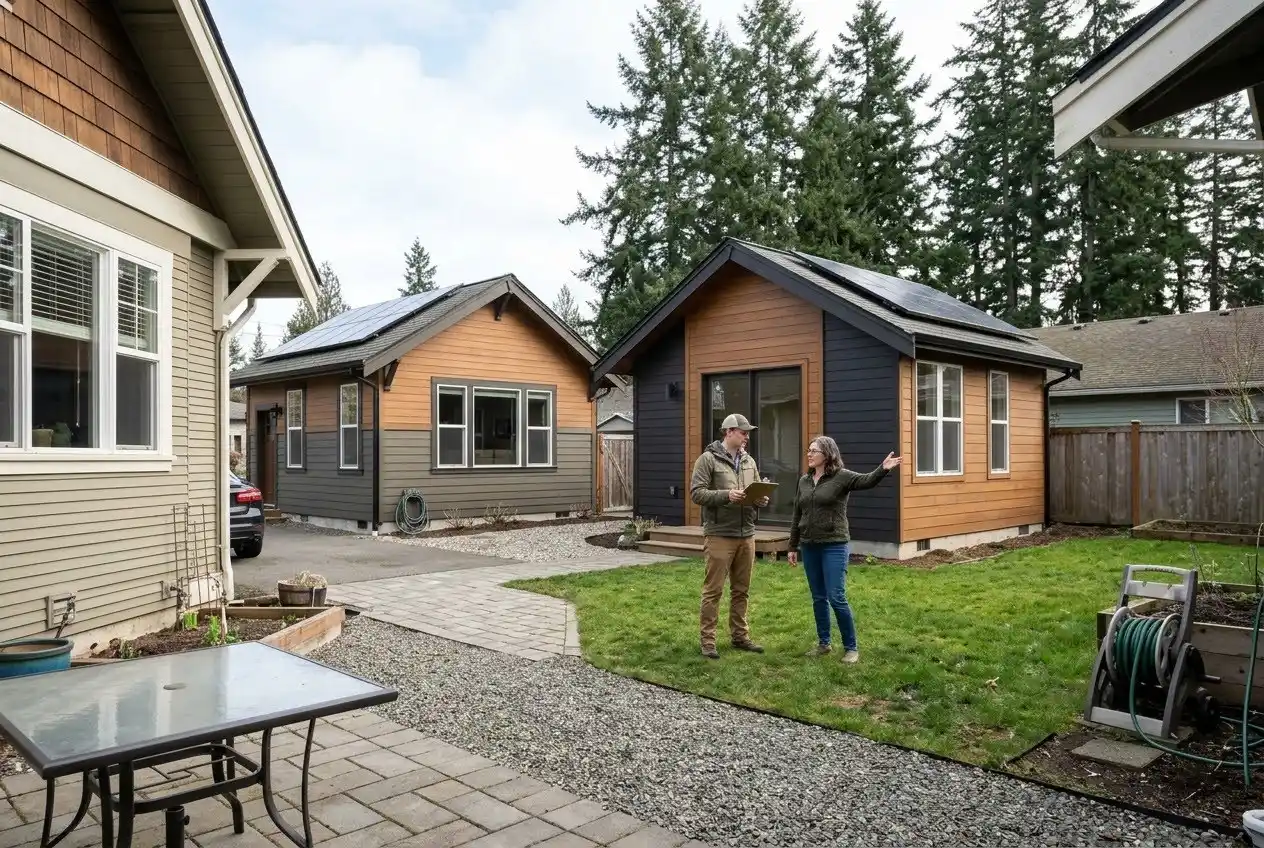
Inside Snohomish city limits, a lot with a principal home may have up to two accessory dwelling units, attached or detached, and no maximum ADU size applies; setbacks control how large a unit can grow. Each ADU needs one off-street parking stall, and short-term rental use requires the owner to live on site.
Those rules come from Chapter 14.170 of the Snohomish Municipal Code, which the city created in 2024 and amended in March 2026. Snohomish layers a few local conditions on top of the state framework: design review in three special districts, a firm line around critical areas and utility connection rules that have been under review. This guide explains each one for owners inside city limits. For the wider regional picture, see our summary of HB 1337 across Puget Sound.
Which Code Applies and How It Has Changed
City Limits or Unincorporated County
A Snohomish mailing address does not mean a lot is inside the city. Many homes with that address sit in unincorporated Snohomish County, which writes its own ADU rules and runs its own permit process. Everything below applies only to parcels within the City of Snohomish limits.
The quickest check is the county’s parcel lookup or a call to the city’s planning department. Settle the question first, because the city and county codes are written separately and differ in their details.
From Ordinance 2495 to Ordinance 2536
The city adopted its ADU chapter through Ordinance 2495 in 2024. In October 2025 the City Council placed an interim control on utility connections, and the ADU rules were sent to the Planning Commission for further work. Ordinance 2536, passed on March 17, 2026, amended the ADU chapter along with sections on detached dwellings and cottage housing.
Local reporting during the review described proposals, including a size cap, that do not appear in the code as published after the amendments. Rely on the current chapter, not news coverage, and ask staff whether anything new is pending.
Up to Two Units That Do Not Count Against Density
Snohomish permits up to two ADUs on any lot that contains a principal dwelling unit. They may be attached to the home, built as a separate structure or one of each.
ADUs are not counted toward maximum residential density calculations. That matters on lots that are already at or near the density their zone allows, because adding accessory units does not use up capacity the way an additional principal home would.
No Square-Footage Cap, So the Setbacks Do the Limiting
Most cities pick a number, usually 1,000 or 1,200 square feet. Snohomish does not; its dimensional table says there is no maximum size and that the unit is subject to setback requirements. On a deep lot, that can mean a two-bedroom cottage larger than many cities would allow. Our overview of how other Washington cities cap ADU size puts this choice in context.
Front, Side and Rear Distances in the ADU Table
The ADU chapter sets these standards:
Front: no detached ADU may be placed in the front setback; an attached ADU in front of the main home follows the zone’s front setback.
Side: 5 feet on an interior side; on a street side, half of the front setback.
Rear: no minimum for a detached unit on an alley; 5 feet for a detached unit without an alley; an attached unit uses the same rear setback as the principal structure.
When the Zone’s Own Setbacks Are Smaller
The chapter adds a useful fallback. If the standard residential setbacks for the underlying zone allow a smaller distance, the smaller setback applies. Lot coverage and other zone standards still apply as well. For plain-language definitions of these terms, read our primer on setbacks, height and lot coverage.
The 24-Foot and 30-Foot Height Split Near Alleys
A detached ADU located less than 4 feet from an alley is limited to 24 feet in height. Everywhere else the limit is 30 feet, measured using the city’s standard height method.
Pulling a cottage up to the alley saves yard space but trims the roof, while setting it back at least 4 feet opens up a full second floor or a steeper pitch. On a narrow lot, sketch both versions.
One Off-Street Stall for Every ADU
Snohomish requires one off-street parking stall for each ADU on a lot, and the rest of the city’s parking chapter applies to how that stall is built and placed. A lot with a house and two ADUs therefore needs room for two additional stalls beyond what the home already provides.
State law removes ADU parking requirements for lots within walking distance of rail stations and bus rapid transit, measured as a half mile to a major stop. Most Snohomish lots are not near that kind of service, so plan on providing the stall unless the city confirms an exemption for your address. Garage conversions deserve extra thought here, since they can remove the space the main house was counting on.
Short-Term Rentals Bring Back the On-Site Owner
Washington’s ADU law bars cities from requiring owners to live on site, and Snohomish follows that rule for long-term rentals and family use. The exception is short-term rental use: if any ADU on the lot is rented short term, the property owner must reside on the site.
Someone living off site can still lease both the house and the ADU to long-term tenants. Our article on living on site and ADU ownership in Washington explains how the statewide rule works.
Design Review in the Historic, Pilchuck and Midtown Districts
New structures containing an ADU in the Historic District, the Pilchuck District or the Midtown District are subject to design review and must be found consistent with the applicable design standards.
The ADU chapter ties this review to new structures. A conversion inside an existing house avoids that trigger, but exterior alterations to buildings in the Historic District may be reviewed under the district’s own standards. Ask planning staff which review applies before finalizing elevations, and allow time for it in the schedule.
Critical Areas, the Rivers and the Sewer Line
ADUs may not be built within critical areas or their buffers as identified in the city’s critical areas chapter. In Snohomish that question comes up most often near the Snohomish and Pilchuck rivers, on bluffs and slopes, and around wetlands. Frequently flooded areas are a critical area category under state growth management law, so a floodplain lot needs early review.
Sewer and water connection rules also shape the project. City code requires a new structure intended for human occupancy on an existing lot within 200 feet of a sewer line to connect to the city’s sewer system, and a sewer connection generally comes with a simultaneous connection to city water. During the 2025 review, local reporting described the interim control as requiring separate meter connections for every ADU, attached or detached. Ask the city which connection standard applies on the day you apply.
Impact Fees at Permit Issuance and a Path to Separate Sale
Snohomish assesses impact fees on ADUs at 50 percent of the rate that would apply to the principal unit, using the rate in effect when the permit is issued.
An ADU can also be sold on its own. The code allows a separate sale through the state condominium process or through the city’s unit lot subdivision process, and a unit lot subdivision for an ADU is an administrative decision. The unit is still treated as accessory to, and on the same lot as, the principal home.
Snohomish and Everett Took Opposite Approaches
The two cities sit a few miles apart but take opposite approaches. Snohomish allows two ADUs with no size cap and requires a stall for each, while Everett defines ADUs as units under 1,000 square feet of habitable space, sets no unit count in most residential zones and requires no car parking for small dwellings. Our guide to Everett’s ADU code covers that city in detail.
To see what fits on a lot inside Snohomish city limits, contact the United Signature team for Snohomish, which designs, permits and builds ADUs and garage conversions in the area.
FAQ
With no size cap, could a Snohomish ADU outsize the main house?
The code sets no maximum ADU size, but it defines an ADU as subordinate to the principal unit. Ask the planning department how that relationship is applied before designing a unit close to, or larger than, the house.
Do I need design review for a backyard cottage on a lot in Snohomish’s Historic District?
Yes. A new structure containing an ADU in the Historic, Pilchuck or Midtown District goes through design review for consistency with the district’s standards.
Does the one-stall rule apply to a basement ADU in Snohomish?
Yes. The requirement is one off-street stall for each ADU on a lot, whether the unit is attached, detached or created inside the existing home.
Can I rent my Snohomish ADU by the night if I live somewhere else?
No. The residency rule applies only when one of the ADUs is rented by the night; units leased to long-term tenants carry no such condition.
Is a Snohomish lot on septic eligible for an ADU?
It depends on distance to the sewer. A new structure intended for occupancy on a lot within 200 feet of a city sewer line must connect, so confirm where the nearest line runs and what connection is required before planning a detached unit.