

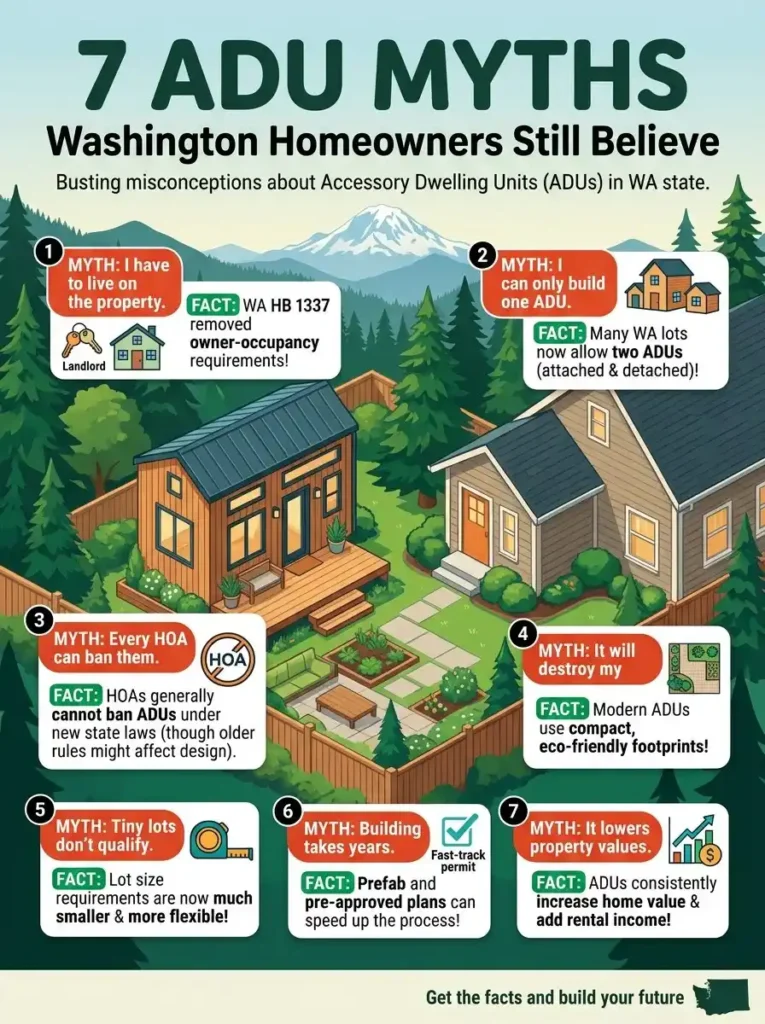
Most ADU myths still repeated in Washington were true at some point. Until HB 1337 and the 2024 and 2025 code updates, many cities required the owner to live on site, allowed a single unit, demanded a parking space and blocked separate sale. Most of those rules are gone, and the limits that remain usually come from the lot.
Outdated advice travels through neighbors, old listings and articles written under earlier codes. Below are seven beliefs we hear on site visits, what the current rules say instead, and where each topic is explained in more depth. One caution applies throughout: the state sets minimum standards, so your city’s code and the features of your parcel still settle the details.
Myth 1: The Owner Has to Occupy One of the Units
This was a standard condition for decades, often recorded against the title so it bound future buyers. Washington now prohibits cities and counties from requiring the owner to occupy either the house or the ADU on lots inside urban growth areas. You can live in the cottage and rent the house, rent both, or live elsewhere.
Short-term rentals are the exception that lets a residency condition return. The City of Snohomish, for example, requires the owner to reside on the property if an ADU there is rented by the night. Your mortgage may also contain its own occupancy terms, which are a contract question rather than a zoning one. Our article on whether you must live on the property covers covenants, lenders and insurance.
Myth 2: A Lot Can Only Have One ADU
State law sets the floor at two ADUs on lots zoned for single-family homes, in any mix of attached and detached. A basement suite plus a backyard cottage, two units inside the house, or two detached units, even stacked in one building, are all protected combinations.
Some cities go further. Everett sets no unit cap in several residential zones, so the lot’s dimensions decide how many homes fit. A few conditions still reduce the count, including critical areas, the absence of public sewer and, in Bothell, a lot that also carries middle housing. The details are in our explainer on how many ADUs Washington lots can hold.
Myth 3: Every ADU Needs a New Parking Space
Within half a mile, measured on foot, of a major transit stop, a city cannot require any off-street parking for an ADU. Farther out, state law caps what a city may ask for, and many cities ask for nothing at all. Seattle and Bothell require no ADU parking anywhere, and Everett exempts dwellings under its small-unit threshold.
Parking has not disappeared everywhere. Snohomish still asks for one stall per ADU, and Mill Creek wants one space per unit away from frequent transit. The answer depends on the city and the walking distance from your door. Our guide to Washington’s ADU parking limits explains the caps and the two exceptions.
Myth 4: An ADU Can Never Be Sold Separately From the House
Washington law now bars cities from prohibiting the sale of a condominium unit solely because it was first built as an ADU. Some cities offer other routes as well; Kirkland and Snohomish, for instance, allow an ADU to be divided onto its own unit lot through a subdivision process.
That does not make a separate sale simple. A condominium requires legal documents, a survey, shared-cost arrangements and buyers whose lenders will finance the unit, and a unit lot subdivision involves city review well beyond the building permit. The statewide rules behind this are summarized in our overview of the baseline every Puget Sound city must meet.
Myth 5: Small Lots Never Qualify
Washington ties ADU eligibility to the lot size a city requires for the house itself, which means a parcel that legally holds a home is not disqualified for being modest. What actually runs short on a compact lot is lot coverage, floor area, setback space and room for construction access.
Those limits push the design in a particular direction rather than ending the project. A basement or attic conversion, a unit stacked over a garage, a cottage at an alley lot line or the conversion of an existing outbuilding can all work where a standalone cottage would not. We walk through these options in our article on building an ADU on a small lot.
Myth 6: The Permit Alone Takes a Year
Review time varies widely, and a long wait is usually caused by something specific: an incomplete application, several rounds of corrections, a steep slope or wetland that needs extra study, or a large tree in the way of the footprint. A simple lot with a complete, consistent submittal moves far faster.
Pre-approved plan programs have also changed the picture. Seattle’s gallery of pre-reviewed backyard cottage designs, Everett’s Residential Basics plans and Kirkland’s pre-approved DADU plans let the city focus its review on how the unit sits on your lot rather than rechecking the whole building. Custom designs still take longer, but a year of permitting is the exception, not the rule.
Myth 7: Rent Will Always Cover the Cost
An ADU can produce steady income, but it does not automatically pay for itself. The result depends on how the project is financed, how long the unit sits empty between tenants, what upkeep and insurance cost each year, how property taxes change and whether the household uses the unit for family instead of renting it. A cottage that houses a parent may be a good decision with no rent at all.
The useful test is whether the plan still works with cautious assumptions about rent and vacancy. If it only works with best-case numbers, it is worth reshaping before design begins. Our honest builder’s list of pros and cons puts income alongside the other reasons owners build.
Where the Real Limits Come From Now
With most of the old blanket rules removed, the questions that decide a project are physical and local. Setbacks, coverage, floor area ratio, height measured on a slope, protected trees, critical areas, the depth and route of the side sewer, and the capacity of the electrical service matter far more than they did when the code itself said no. Private covenants and homeowner association rules are a separate layer that the state ADU law does not erase.
Building, energy and fire codes also apply to every ADU as they do to any home. A converted garage may sit legally inside today’s setbacks, yet still need insulation, a new slab or fire-rated walls before anyone can live in it.
Checking Your Parcel Instead of Relying on Hearsay
The fastest way past outdated assumptions is to look at the facts for one address. A free feasibility report on your lot pulls zoning, setbacks, slope, flood risk and utility information from public records, so the conversation with your family or a designer starts from what your parcel actually allows rather than from what a neighbor heard years ago.
FAQ
Did HB 1337 wipe out every local ADU restriction in Washington?
No. The law created a statewide baseline for urban growth areas, not a ban on local rules. Cities can still limit short-term rentals, restrict ADUs on lots without public sewer and apply critical-area rules, and rural parcels follow county codes.
Do ADUs still face design review that the main house would not?
Not under state law. State law keeps a city from holding the ADU to tougher appearance or design-review standards than the house on the same lot. Where a district reviews the design of every new building, such as a historic district, an ADU can be reviewed on the same terms.
Is an old garage that sits too close to the property line impossible to convert?
Usually not. State law protects conversions of buildings that already stand on the lot, even ones that sit closer to the lines than today’s code allows. Building, energy and fire requirements for a home still apply once the space is converted.
Is 1,000 square feet the largest ADU allowed everywhere in Washington?
No. A city that caps ADU size may not set the cap below 1,000 square feet, and several Puget Sound cities allow 1,200. The City of Snohomish sets no maximum size and lets setbacks and coverage control the footprint.
Why do so many websites still describe the old ADU rules?
Many local codes changed in 2024 and 2025, and older copies of those codes, city handouts and blog posts remain online. Check the date on anything you read, and rely on the city’s current code or planning staff for a final answer.